Wednesday, October 20, 2021

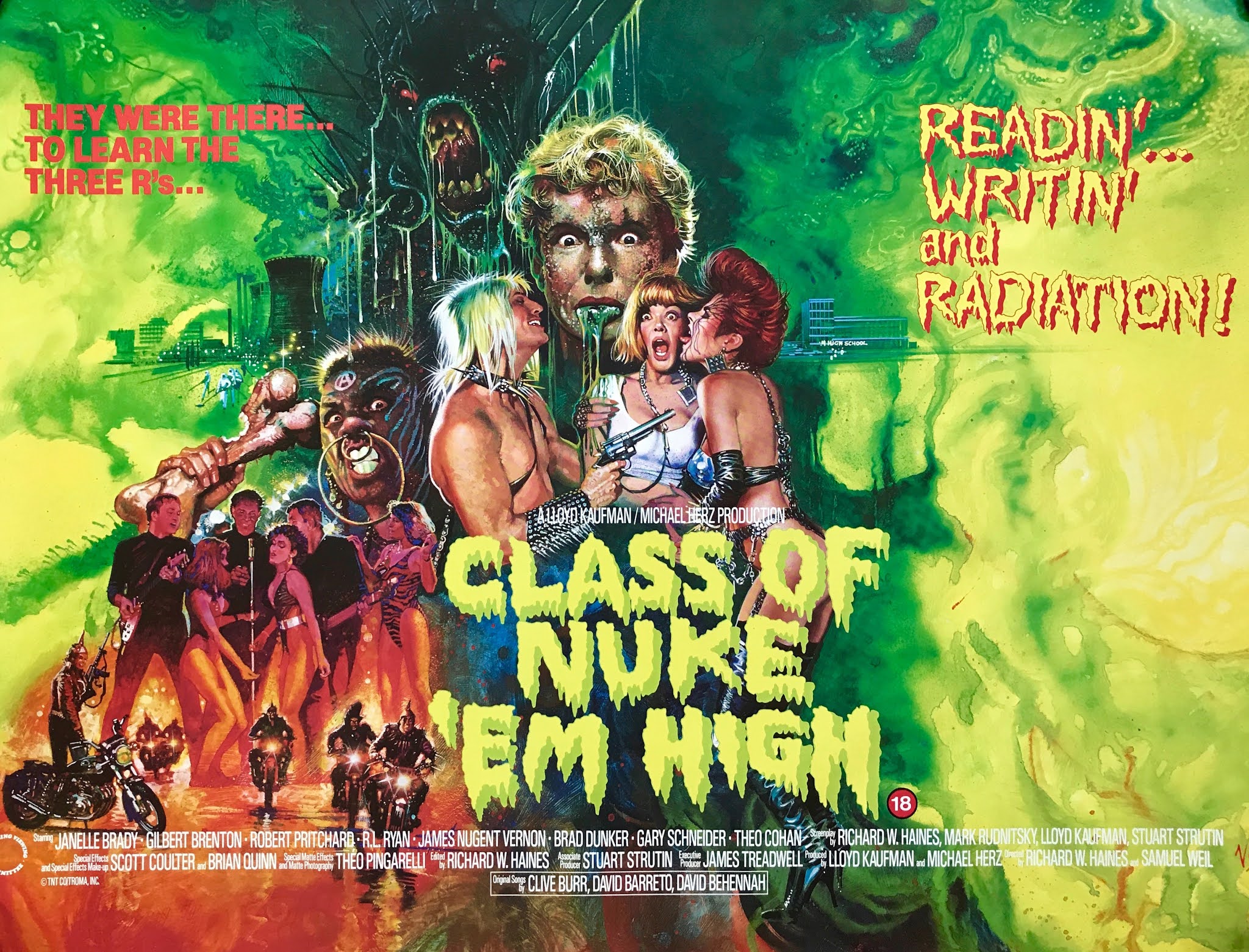
The Long Dark Marathon of the Soul 2021: Class of Nuke’em High (1986), directed by Richard W. Haines, Michael Herz and Lloyd Kaufman


and

The Appropriate Tune - "Nuke Em High" by Ethan & The Coup


       It’s been a while since we’ve taken a look into the wacky world of Troma, hasn’t it? Now granted that’s pretty easy to do, given that many of the films associated with Troma Entertainment are Z-grade schlock who try so hard to be camp that it swings back around and becomes embarrassing. I can’t really hate on them though; Besides the fact that shitting on Troma for being cheap garbage is like shitting on the sun for being bright, they were there when a young Thunderbird was on the cusp of my writing-about-movies destiny, and so nostalgia is a definite. Perhaps the genre-centric direction of the blog is because of Troma? Nah, probably not, but in my flurry of movie selection whimsy I decided to rewatch a Troma film that I actually remember being pretty good. Then again anything looks good after you’ve sat through Sgt. Kabukiman, so I guess we’ll see if the memory holds up.


       Released in 1986, Class of Nuke’em High was written by Richard W. Haines, Lloyd Kaufman, Mark Rudnitsky and Stuart Strutin, directed by Haines, Kaufman and Michael Herz, and produced by Herz, Kaufman and James Treadwell. Gil Brenton stars as Warren Brandt, your typical white-meat American teenager just trying to keep his nose clean and maybe get some from his girlfriend Chrissy (Janelle Brady) while attending Tromaville High School. Tromaville High, too, is your typical white-meat American High School; It has its overly-hormonal teenagers, its gangbangers, and it just so happens to be a quarter mile downwind from a nuclear power plant so shoddily maintained they think OSHA is Oprah’s cousin. Sure there’s toxic waste bubbling out of the ground and maybe a kid melted that one time, who can possibly worry about that when there’s parties and unprotected sex to be had? When that nuclear sludge gets into the weed supply however, it sets into motion a chain of events that could spell disaster for the students and faculty of Tromaville High School. More like Nuke’em High, am I right? Yes I am, because that’s the title of the movie.


       There was of course no shortage of high school comedies in the 80’s, that was practically its Golden Age, but of course Troma’s whole gimmick is about giving a 10 when it calls for a 5. You ask for a punk and Nuke’em High gives you the cast of Mad Max, you call for a death scene and Nuke’em High has people getting their heads exploded, and their parties look like something out of a Fellini movie (their words, not mine). Much like its sister film The Toxic Avenger, Class of Nuke’emHigh has this kind of chaotic screwball energy to it where it never makes the audience wait too long for something to happen, and even in the ancillary scenes there’s usually something going on in the background to keep your eyes busy. If Animal House were written by the folks of Mad Magazine, that’s what this movie feels like.


       The other thing that connects it to The Toxic Avenger and separates it from a lot of the Troma fare is that overall it’s a well made film. While intentionally crude it never fully leaps into the cold waters of bad taste like Kabukiman, and while presenting itself as dumb it manages to skewer the romanticization of high school and nuclear energy policies in a way that hits more than it misses. This is due partly to the material and also the cast, who might not be Oscar-worthy but always feel exactly like the model version of their respective stereotype. I especially liked the late Pat Ryan here as the villainous plant manager Mr. Finley. He played a similar character in The Toxic Avenger a few years before and to me he was as big a part of that movie’s success as Toxie himself. A proper B-movie actor, who also kind of looks like early MadTV era Will Sasso.


       It wouldn’t be a proper B-movie without some of them there special effects, and in true Trome fashion Nuke’em High delivers on that. Gushing pustules of mysterious fluid, distended body parts, exploding heads, all the things you shouldn’t type into a pornhub search bar in a way that looks like actual time and effort was put in. We even get a radioactive semen monster (watch and find out) at the end that I think could stand with any other sci-fi or horror movie of the day. Of course you never actually see the monster do anything besides moving its head, any kills being performed by claws and a tail that conveniently arrive from off screen, but the overall design is solid and shows Troma’s dedication to the absurd despite the film already being ridiculous enough.

       I also unironically love the soundtrack. The Smithereens had released their debut album Especially for You the year this film came out, and it’s surreal to see the group responsible for the proto-’Come As You Are’ ballad ‘Blood and Roses’ having a cameo in a Troma film for some reason. The Nuke’em High theme song is also a banger; It was going on 10 years since I had last seen this film before the review, and yet I still found myself humming the tune from time to time, it’s almost annoying how catchy it is.


       Class of Nuke’em High is schlock. Troma markets it as schlock, and in both form and content its schlock. Yet despite being rough around the edges I never found myself bored at any point. It’s entertaining; the kind of gonzo film that through our modern lens we envision all of 80s pop culture to be, though the truth is a lot more mundane. The Class of Nuke’em High gets the recommendation: it’s definitely not a movie for the kids or the easily offended, but if you have a couple friends and more than a couple beers over one night and pop this in I think you’ll manage to have a good time. As long as you avoid the weed that is.

Tuesday, October 19, 2021

The Long Dark Marathon of the Soul 2021: Candyman (1992), directed by Bernard Rose


and

The Appropriate Tune - "Helen's Theme" by Philip Glass


       Well well well. Here I thought that the days of having a movie adapted from a Stephen King story and one from Clive Barker were over, but then I decided completely on a whim to do a formal writeup of a film that I watched years and years ago, and it turns out that movie was a Clive Barker story all along! I know pulse-pounding moments like these are common on this blog, which is why the viewer base is so high, but it was still a pleasant surprise. What are the odds, right?


       Anyway,


       Released in 1992, Candyman was written and directed by Bernard Rose and produced by Steve Golin, Sigurjon Sighvatsson and Alan Poul through Propaganda Films, based on the short story “The Forbidden” by Clive Barker. Virginia Madsen plays Helen Lyle, a student from the University of Illinois working on her graduate thesis on the nature and development of urban legends with her friend Bernadette (Kasi Lemmons). During their investigation however, there is one name that keeps coming up: Candyman (Tony Todd), a supernatural serial killer who murders anyone who dares to speak his name into a mirror five times with his big fuck-off meathook (and that’s not a euphemism for his dick). Candyman is said to haunt the Cabrini Green housing projects, and indeed the residents there attribute a rash of murders in the area to him, including a woman named Ruthie Jean who was murdered by a man with a hook who allegedly came in through her bathroom window. Smelling the opportunity to up her thesis game, Helen decides to visit Cabrini Green and dig up some dirt on this whole sordid business. Something which on its own would not be advisable, but then she has to take things a step further and call him up. Now the Candyman has his sights on her, and before he kills her he’s going to make her life a living hell before he finishes her off for good. Also he’s really into bees, so I’m not sure why they didn’t call him Honeyman.


        Let’s start with the cinematography, like Bernard Rose’s love for aerial shots. The movie opens on a top-down view of Chicago, just about every scene that takes place in the university begins with a top-down view of the campus, even Cabrini Green gets it at one point and I’m not exactly sure why beyond that it looks good and Kubrickian. There is some good camera work on the ground too, the shot of Helen peering out of a hole in the wall which has been spray painted to look like Candyman’s open mouth is definitely a visual to sell a movie on. It’s not on the level of a Jodorowsky or anything, but these little touches do help Candyman stand apart a bit from its supernatural horror.


       Another one of those little touches comes from the score, composed by minimalist pioneer Philip Glass. Glass is perhaps best known for his work in avant-garde theater and cinema like Koyaanisqatsi, but over the years he’s sprung up in various film and TV projects, including Candyman’s sequel Farewell to the Flesh. On the whole I think Glass lives up to his reputation, his music really serves to give the film a level of grandiosity that you might not have expected., at least when you get into the film proper. For whatever reason the opening piece of music sounded off to me, more like the theme song to a cheap horror TV show than something by an acclaimed composer. It actually threw me off in the beginning, because I’m familiar with the work of Philip Glass and this wasn’t exactly Einstein on the Beach, but it quickly righted itself.


       Righted itself on the music front at least, unfortunately I can’t say the same for the watchability. As has been made clear from the Rosemary’s Baby review back in the day I find these ‘misery porn’ kind of horror movies, where the protagonist is behind the eight ball for the entire film with no agency whatsoever to be extremely tedious, but I think Rosemary might have actually been more active than Helen in this movie. After the first act it’s like we’re put on rails waiting for the haunted house ride to end. There’s no attempt to investigate Candyman beyond the little backstory we’re given, no real attempt at combating him, she’s just the metaphorical (and at one point literal) punching bag for the rest of the film. That we get some Virginia Madsen sideboob at one point, and a generous amount to boot, does little to soften the blow. Unless you’re into decapitated animals and buckets of blood with it that is, in which case you should probably call a psychiatrist.


        The whole ‘Helen as abuse sponge’ angle might have been tolerable though if our titular character were a Freddy Krueger type of villain, a malicious trickster who can bring a bit of gallows humor to the horror, but unfortunately he’s a retread of Pinhead without the unique visual aesthetic to distract you from him constantly dropping spooky obscure one-liners. Or they could have tied it into his backstory, and yes they are pulling the old Mummy trick by implying that Candyman is targeting Helen because she looks like his lost love (who he wants to psychologically destroy and then murder for some reason), but that’s only at the very end. Honestly it feels like an afterthought even though they telegraph it at the beginning of the movie as that whole past relationship angle is never really delved into at all, so Candyman is just acting like a weird psycho-rapist for no reason, which is on top of somehow being a murder ghost who needs to kill people in order for them to tell his story and thus continue to exist. Tony Todd does put the work in to make an otherwise indistinct villain more engaging, so props to him.


        Ultimately Candyman gets a mild recommendation. It’s always a treat to get some diverse casting in horror movies, and those readers who came out of Hellraiser and Nightbreed wanting will find another scrumptious meal of gruesome imagery and BDSM fetish fuel from the mind of Clive Barker and adapted reasonably well by Bernard Rose. Personally though Candyman feels like a short story stretched just far enough that the cracks in the concept became noticeable, and the misery porn direction the plot went to made the experience tiresome by the end. If you’re looking for scary movies to watch this Halloween and you’ve gone through the big names already then pop Candyman in and see where the night takes you, but I think one viewing is going to be the limit.

Monday, October 18, 2021

The Long Dark Marathon of the Soul 2021: The Elephant Man (1980), directed by David Lynch


and

The Appropriate Tune - "Elephant Talk" by King Crimson


       Not everyone makes that jump from the minors to the major leagues. Josh Trank was an indie darling after the release of his film Chronicle, Disney was ready to give him one of the keys to the Star Wars castle, but then he took his first step out of the gate and he fell into a fantastic hole, gone forever until last year when he showed up with that Capone movie no one talks about. Contrast that with the Russo Brothers, directors of those paintball episodes on Community, and parlayed that into smacking life-size action figures around at Marvel. The movie business, like all businesses, is shitty and terrible, and to succeed in it depends a lot on how well you handle yourself under extreme pressure from the waves of bullshit. Trank couldn’t handle it and the Russos could, and we can see the results.


       Then we have David Lynch. When he released his directorial debut Eraserhead in 1977 it quickly became one of the most successful independent films in the country, and big studios came calling, and yet it doesn’t feel like he ever stopped making indie films. The budgets grew larger of course, the actors more prestigious, he even tried his hand at a franchise, but David Lynch’s films always felt like David Lynch. He stuck to his guns, made the films he wanted to make (besides Dune I guess) and now he’s regarded as one of the great talents in American cinema, so all you young directors keep a stiff upper lip or whatever. So with only a few movies left to go before this blog closes its book on this icon of moving pictures, this year the Marathon is going to shine the spotlight on David Lynch’s big break. The film that proved Eraserhead wasn’t just a flash in the pan but the harbinger of a great talent. It’s still got weird stuff though, because hey, studios aren’t going to take that much of a risk.


       Released in 1980, The Elephant Man was written by Christopher De Vore, Eric Bergen and David Lynch, directed by David Lynch and produced by Jonathan Sanger though Brooksfilms, based on “The Elephant Man and Other Reminiscences” by Frederick Treves and “The Elephant Man: A Study in Human Dignity” by Ashley Montagu. Anthony Hopkins plays Frederick Treves,, a young up-and-coming doctor taking in the local carnival when he comes across the greatest ‘freak’ of them all -- The Elephant Man, played by John Hurt, possessed of such serious physical deformities that it’s a miracle that he’s alive, as ironic as it might be to use that word in this case. Initially Treves is only interested in The Elephant Man, real name John Merrick, as a curiosity, something to trot out to his friends in the medical community as a example of how fucked up human anatomy can get, but as he spends time with Merrick he learns that this is not some abomination of nature, but a gentle, intelligent young man. Treves is touched by Merrick’s noble spirit, and as the story of the Elephant Man makes its way through the London media more people get to know John Merrick, and are changed in much the same way. Of course for all of those people who can see beyond Merrick’s appearance there are many who don’t, and they’ll do whatever it takes to see that last little spark of light within Merrick’s heart is snuffed out forever. Whether they will or not, however, remains to be seen.


       The Elephant Man occupies an interesting place in David Lynch’s development as a filmmaker. More strait-laced than Eraserhead before it, not as ‘compromised’ by outside voices as Dune supposedly was after it, Elephant Man is at this crossroads that ends up making it feel unique to the filmmaker’s canon. There are aspects of the film that are distinctly Lynchian; The editing on the dream sequences, there’s the repeated focus on industry, the use of overwhelming silence, all things that would return in later films, it feels less like a predecessor to Blue Velvet and more like a long-lost Universal Monster movie, with the unfortunate John Merrick feeling perfectly natural alongside Frankenstein’s Monster and the Phantom of the Opera. Which to me is a treat, as it’s not often that we Lynch be so straight-forward in his storytelling, and so when they do touch upon those more standard Lynchian moments they stand out all the more.


        It’s not often you see David Lynch doing period pieces either, although the steel-and-coal industrial hell that is Victorian London in this film is not far removed from the world of Eraserhead. We don’t get any big money scenic shots, in fact the film feels rather claustrophobic at times, but the scenes we do get are very well-crafted. It really does give the feeling of late 19th London, a character walks down a rain soaked street and you can almost smell the odor of human feces and rotting fish. The interiors look very good as well, sans Merrick’s bare bones room. Certainly an aspect of the film I wish we got even more of, but then I’ve always had a soft spot for that aesthetic.  


       Of course when you have a movie called The Elephant Man audiences expect an Elephant Man, and David Lynch and designer Christopher Tucker deliver on that. I mentioned the similarity between Merrick and the old Universal monsters, but John Hurt is transformed in a way that Boris Karloff and Lon Chaney never were, I honestly wouldn’t be able to tell you it’s him in the make-up if I didn’t know beforehand. As with Karloff before him though, it is really the strength of Hurt’s acting that brings this interpretation of John Merrick to life, drawing the audience in with only one eye and his voice. There’s also some great work here by Hannah Gordon (who plays Treves’ wife Ann), Freddie Jones (as the properly Lynchian freak show proprietor Mr. Bytes), and of course Anthony Hopkins as Fred Treves, but it is principally Hurt’s game to win, and he nails it.


       If there is a problem with the film then, it’s one of momentum. While the basic idea of Merrick going from being regarded as a subhuman creature to being favored by the Queen and all is solid, there’s no real drive to it. Merrick is understandably a passive character, so things just sort of happen around him.which ends up feeling like you’re waiting around for things to resolve themselves. The greatest source of drama in this drama film comes from Mr. Bytes, which ties into a subplot with the night guardsman of the hospital that the film largely takes place in, but even that seems to be over as soon as it begins. There’s not much in the way of character development beyond Merrick either; Plenty of characters go from hating Merrick to liking him, but the only one to be given significant focus is Treves, who is conflicted over his friendship with Merrick and his nagging doubts that he isn’t any different than Bytes in the end. Except that doesn’t really go anywhere? He’s upset over it in one scene but then never brings it up again, and he never really acts any different. The film makes a big deal about this mirroring the actual events of Merrick’s life and that’s fine, there’s no need to invent a love interest for the Elephant Man or something like that, but it does have this sedate quality that demands you fall into its pace more so than other drama films. Even other dramas by Lynch in this case, as The Straight Story has a similar energy level and yet because the film is predicated on the journey the audience doesn’t feel like it’s just waiting around for something to happen.


       That being said, I’m giving The Elephant Man the recommendation. It’s not the film I would choose to showcase David Lynch the auteur, but it’s a solid film and the performances, the make-up design, the cinematography, the music are all good. Moreover it’s a significant film, one that shows that Eraserhead wasn’t a fluke and that David Lynch was a director to watch out for, as long as he was given the tools and the opportunity to succeed. So if you’re in a chill mood this Halloween, maybe up for a good cry, or if you’re actually Karl Pilkington, you should pop in The Elephant Man and see how the night goes. You just might enjoy yourself.

Sunday, October 17, 2021

The Long Dark Marathon of the Soul 2021: To Catch a Thief (1955), directed by Alfred Hitchcock


and

The Appropriate Tune - "To Catch A Thief" by Lovage


       I wasn’t intending for Alfred Hitchcock to end up like Terry Gilliam or David Lynch where he gets an entry year after year, but I can’t deny that he’s a great time-saver. Crafting these lists every year isn’t the hardest thing in the world, but the amount of times I revise which movies end up on the final print is annoyingly high. Does it seem interesting enough to talk about? Does it fit the criteria? Do I feel like it? Just a constant filtering program that leaves me in a perpetual state of second guessing myself, and it’s exhausting. Sometimes what you want is the cinematic equivalent of the station wagon; Solid, reliable, wood paneling, all of that good stuff. That’s what Hitchcock’s films have been for me lately: whenever I’ve had a particularly hard time deciding on films, I just take a step back and throw on Hitchcock, because I know there’s going to be something worth talking about when it comes to his films. Also, because many of his films are ‘thrillers’, thus falling under the nebulous label of genre films, it means I have one less movie to worry about for years to come. Quite the boon.


       Released in 1955, To Catch a Thief was written by John Michael Hayes and directed and produced by Alfred Hitchcock, based on the book by David Dodge. Cary Grant stars as John Robie, a humble grape and flower seller who years before terrorized the French Riviera as The Cat, master jewel thief. After serving with the Resistance during WW2 Robie earned himself a parole and had made good use of it, but when a new rash of jewel thefts occur, all of which are identical in style to his old work, all eyes turn to him. Uninterested in being thrown in prison for a crime he didn’t commit, Robie goes on a hunt for the copycat, casing the same joints and people that he would in order to root them out. Which would be fine if that was all he was doing, but when he meets the beautiful Francine Stephens (Grace Kelly), his best laid plans threaten to go awry.


       To Catch a Thief is certainly the most extravagant of all the Hitchcock films reviewed so far. The seaside villas, the hotels, the mansions, one wonders where the people who actually work for a living are supposed to fit in between all this luxury. You couldn’t ask for a better setting for a story as removed from the general populace as this one is though, and Hitchcock makes full use of it. Every single shot we get of the coastline and the city, especially the aerial views during the driving scenes, make it look almost otherworldly, the kind of place you thought existed only on postcards. The opening shot of the film is of the window of a travel agency advertising trips to France, and after watching this movie I want to go just to see if this place is real.


A new setting, but Hitchcock’s penchant for marquee names remains intact. Cary Grant makes his third appearance in the filmography, his last being Notorious almost a decade previous, and despite looking a bit leathery under the Riviera sun I think he paints a interesting picture of the character of John Robie; Charming and intelligent but at the same time cynical and aloof, the kind of guy who is fun to hang out with but who never wants to hang out. Grace Kelly also makes her return after co-starring in Rear Window, one of her last films before retiring from Hollywood to become the Princess of Monaco (look it up) and once again it’s obvious why Hitchcock wanted to bring her back, because she looks like Grace Kelly. Her performance as Francine Stephens here is not too different from her character in Rear Window, the naive yet paradoxically witty and seductive woman who inserts herself into the protagonist’s life which ultimately leads to romance, although the whole ‘woman acts like a bratty kid because that’s cute’ thing tends to miss more than it hits, and overall I found her character in Rear Window far more endearing. John Williams, who appeared in Dial M for Murder and The Paradine Case as insurance agent H.H. Hughson, a man so overwhelmingly British you’d swear he pisses Earl Grey. Jessie Royce Landis (who would show up again along with Cary Grant in North by Northwest) plays Francine’s sassy mother Jessie, and honestly that bit of snark makes her my favorite character of the film. She’s also one of those actors who you’d swear was in everything because she has that certain look but that’s not the case, although she did have a career that stretched from the 30’s to the 70’s. Solid casting to be sure.


Unfortunately the concept of To Catch a Thief is more interesting than the execution. You hear the elevator pitch of a master thief forced to come out of retirement to hunt for another to clear his name and it gives the impression of a tense mystery-thriller, but that’s not really this film. There is a mystery that slowly unfolds over the course of the film, but it never feels like Robie is actively figuring anything out. There are a couple scenes where Robie has to sneak around or escape the cops but there’s no real sense of urgency to those scenes to really get the blood pumping. Most of the film is dedicated to building the romance between Robie and Francine, but despite the fact that Grant and Kelly are fine actors I don’t think they have any chemistry together. That’s the problem with the film as a whole in a way: no spark. The film looks good, sure, but there’s no stakes; It’s not like anybody cares if a bunch of rich people have their baubles stolen, and the biggest tension comes from Robie getting caught by the police, which is only a thing because he’s purposefully staking out the places that a thief would hang out in. Not that a film needs action to be good, but for a director who built their career on suspense this film lacks bite.


       To Catch a Thief gets the tentative recommendation. Getting that view of the French Riviera is great, and Hitchcock being Hitchcock still knows how to construct a watchable movie, but this is the first Hitchcock film I’ve reviewed that is definitively not a must-see. Put it on the queue if it’s there, maybe make it a movie date with the SO, but if it’s between this and Rear Window or Rope, then go for the other option. Less chance of contracting a deadly respiratory virus than actually visiting the French Riviera these days though, so that’s a plus.

Saturday, October 16, 2021

The Long Dark Marathon of the Soul 2021: The Dead Zone (1983), directed by David Cronenberg


and

The Appropriate Tune - "The Future Freaks Me Out" by Motion City Soundtrack


       If you’ve ever needed a visual aid to distinguish between strong and weak directors, look no further than Stephen King. Just about everything that man has put down on a page and put on a screen, from good to the coke-fueled, whiskey-soaked worst, and so the real challenge for the filmmaker is in how well he manages to adapt the material. Christine is literally a movie about an evil car, and yet John Carpenter managed to make it into one of the better films of his career and the decade. Stand By Me is about a bunch of weirdo kids who want to look at a corpse, but Rob Reiner managed to make it the coming-of-age movie that all future coming-of-age movies aspire to be. Conversely, Cujo is about a mother and her kid being menaced by a rabid dog, which seems like a good foundation for a thriller, but you never hear anyone speak about it or its director Lewis Teague in the same way they talk about Kubrick and The Shining. You can point to differing levels of budget or studio interference for these films and that is reasonable to an extent, but at the end of the day it comes down to how well you use the tools you have available. 


       Conveniently our unofficial rule of one Stephen King adaptation a year coincides with our annual appearance by Mr. Body Horror himself, David Cronenberg. Over the years I’ve found myself increasingly unable to place Cronenberg on the Bell curve of directors; He’s certainly has a mind for the grotesque and the ability to project that in his films in a way that not many directors are willing to do, and if they are not as successfully at the box office. Despite that, I’ve often found myself mixed on the films as films rather than just special effects showcases. Scanners was cool but the protagonist was a walking plank of wood, Crash was interesting but often like a porno on Ambien, and for a movie that involves performing oral sex with an open wound it felt like eXistenZ was constantly dragging its feet as it shuffled through the plot. I’m conflicted, so I’ve decided to take my own advice and see how one of one of the big names of 80s horror films tackles the material of one of the big names of 80’s horror literature. No, not Clive Barker, even though that seems like the obvious pairing, the other one.


       Released in 1983 (the same year as Videodrome), The Dead Zone was written by Jeffrey Boam, directed by David Cronenberg and produced by Debra Hill through the Dino De Laurentiis Company, based on the novel of the same name by Stephen King. Christopher Walken plays Johnny Smith, a respected English teacher and beloved boyfriend who one night collides into the side of a runaway milk truck. Five years later he awakes to find that the life he once knew is gone. Not only has he lost his teaching position but his girlfriend Sara (Brooke Adams) as well, who is now married to some guy who isn’t Christopher Walken and even has a kid. Coupled with this great loss however Johnny has somehow been granted an interesting gift: he is now psychic, able to see into a person’s past, present, and future with only a touch of their hand. Of course when you just woke up to find your entire life in pieces  the idea of playing Miss Cleo to every Tom, Dick and Harry off the street is the furthest thing, but as Johnny’s powers grow they cry out to be used, and no matter what he seems to do he keeps getting dragged into action. Which is the sort of behaviour that can get you in a lot of hot water, especially when Greg Stillson (Martin Sheen) enters the picture, a man with his eyes on the Senate and more than a few skeletons in his closet.


       As a story, The Dead Zone has a clear through-line of influence that traces back to the speculative fiction of Ray Bradbury, Rod Serling and the like. It presents us with a simple question: if you had the power to effect change, and you were the only one who could do it, would you do it in spite of the consequences? Does great power indeed come with great responsibility? For Stephen King, the answer is yes. After the accident ruins his life Johnny has little incentive to use his powers to help anyone; Indeed, Johnny is outright punished for using his powers throughout the course of the film beyond just being a social pariah, and yet each time he is confronted with the choice he chooses to help because he is fundamentally a good person. King’s choice to name his character ‘John Smith’, one of the most generic names in the book, was no accident; It was him saying that everyone had the potential to do what was right. Not too bad for the guy who wrote a story about an evil car.


       As an adaptation of the story though, I found The Dead Zone to be...simple I guess is close enough. It says what it needs to say to get the point across, sure, although perhaps in the truncated way that some adaptations do where it constantly feels like you’re missing half the book, but that’s where it stops. Were it not for the cast and the run time this feels more like an episode of Ray Bradbury Theater or the 90s Outer Limits than a multi-million dollar film. Spectacle for spectacle’s sake isn’t all that appealing, but we’re talking about David Cronenberg here. This is a filmmaker whose interests lie in the grotesque; Psychological extremes, sexual extremes, visual extremes in the case of his body horror, and yet everything about The Dead Zone feels by-the-books. Even when we get to the part of the film dealing with the Castle Rock Killer, something that sounds right up Cronenberg’s alley, it feels incredibly tame by his standards. Perhaps after the one-two punch of Scanners and Videodrome this was meant to be his big break movie, and he decided or was told to soften his tone to make it more accessible, but if that was the case I don’t think it was as successful as when the push was given to David Lynch or Paul Verhoeven. Or maybe I’ve just seen the big Cronenberg movies and I expect all of them to be weird as shit, who can say?


       I’m also not sure that the choice to cast Christopher Walken in the lead role was the best one. While Walken is a fine actor, even when he is a parody of himself, he lacks that quiet, everyman quality that the role calls for. He’s too intense; Every time he interacts with another human being it feels like he’s three seconds away from caving their skull in with a hammer, and setting him against the beautiful Brooke Adams doesn’t help assuage that feeling. On the other hand Martin Sheen is perfect as the boisterous, egomaniacal Greg Stillson, and the contrast between the apple pie eating, flag-waving patriot and this lumbering vampire is great visual storytelling. 


       While The Dead Zone is definitely not the flashiest movie of Cronenberg’s career (although the acting alone puts this over Scanners), he still put together an enjoyable film, and in terms of King adaptations that actually places it close to the top. The Dead Zone gets the recommendation; Perhaps not your first choice when you’re looking for genre films, but nevertheless a solid. And yes, there was a Dead Zone TV show a while back that made Johnny into a psychic detective playing around with the local cops solving crime, even though that cheapens everything about Johnny’s decision to help catch the Castle Rock Killer and the toll using his powers cost him physically and spiritually. Might as well just watch Psych instead.

Friday, October 15, 2021

The Long Dark Marathon of the Soul 2021: Heavy Metal (1981), directed by Gerald Potterton


and

The Appropriate Tune - "Heavy Metal" by Sammy Hagar


       In 1974 a group of four Frenchman, Jean Giraud, Phillippe Druillet, Jean-Pierre Dionnet and Bernard Farkas came together to launch the magazine Mètal hurlant, or Heavy Metal as it came to be known in the United States. Much like the British magazine 2000 AD released three years later, Heavy Metal was an anthology series, showcasing comic adaptations of science fiction and horror stories by established novelists and writers like Harlan Ellison and Grant Morrison. Although it never had a breakout star like 2000 AD’s Judge Dredd it did have a large following, due in part to the amazing work by artists like Jean Giraud (also known as Moebius) which only highlighted its more risque, experimental material. Although its parent company has undergone some changes over the years, it’s run by Heavy Metal Media LLC at the moment, the American version of the magazine has been running consistently since 1977, which is pretty good when you consider that no one reads magazines anymore.


       That this kind of niche genre magazine would spawn it’s own theatrical film feels almost unbelievable in hindsight, and that it would be animated is almost like a dream. Take Ralph Bakshi out of the equation and you could probably count the amount of adult-oriented animated films coming out of Western theaters on one hand, and most of those would probably be in French (so few that I’ve actually already seen this film, but it was so long ago that impressions should be suitably fresh). Or perhaps this was the only time that it could happen, when Star Wars and Dungeons and Dragons was sweeping across the youth of America and studios were throwing bags of money at anything and everything that they saw in the hopes of it becoming the next big thing. I mean if Buck Rogers and Flash Gordon got their own movies and TV series despite not being relevant since the Eisenhower administration, then why not take a chance with something popular AND current? This is the 1980’s baby, nothing but smooth sailing from here on out.


       Released in 1981, Heavy Metal was written by Daniel Goldberg and Len Blum (based on stories by Dan O’Bannon, Richard Corben, Bernie Wrightson, Angus McKie and Thomas Warkentin), directed by Gerald Potterton, and produced by Ivan Reitman (Animal House, Ghostbusters, et cetera) through Potterton Productions. One day in the infinite vacuum of space, an astronaut drops out of a space shuttle in a muscle car and lands on a nearby planet. The astronaut’s name is Grimaldi, and he’s just returned home to give his daughter a gift from his interstellar travels: a glowing green orb. This turns out to be a mistake, as the orb immediately melts Grimaldi like he’s ice cream on a hot. It turns out that not only is this orb sentient, it’s also the sum of all evil, whose powers are beyond human comprehension. With the girl as his unwilling captive, the orb (or the Loc-Nar as we come to learn) shows her visions of its history and the various ways it has inserted itself into the lives and humanity and twisted events toward its own ends. In one it is the dystopian year of 2031 a New York cabbie named Harry Canyon is pulled into a web of stolen jewels and mobsters. In another, a teenage boy finds a strange glowing meteorite in his backyard that transports him to another world and another body. What is the purpose of the Loc-Nar’s visions? What is its goal? Probably nothing good, you know considering the whole ‘sum of all evil’ thing, but you know how magic orbs can be.


       As I wrote earlier it was the art that made the Heavy Metal magazine as big as it was, and it is the same for the Heavy Metal film. I don’t think I’ve seen anything like it before really; Gandahar and Bakshi’s Fire & Ice are similar, but neither of those films comes close to the diversity of art and animation showcased in Heavy Metal, which makes sense when you consider Potterton’s previous work on another famously wild animated feature, the Beatles’ Yellow Submarine. From rotoscoping to hand-drawn animation, from realism to the cartoon and the grotesque, from incredibly intricate painted landscapes to the swirling paint backgrounds you’d see in something like Zabriskie Point, and shit like the opening scene with the muscle car where I don’t even know what I’m looking at, I thought it was stop-motion at first. Not only does it serve to make each individual story and thus the film as a whole feel unique but the wild experimentation makes it easier to forgive issues like the slow animation speed in many scenes, which studious readers will recall was the death knell for Rock & Rule in my opinion. If you ever wished looking at prog rock album covers were a multimedia experience, look no further than Heavy Metal.


       Besides the art, the other thing that made Heavy Metal an instant cult classic was it’s star-studded soundtrack that contained very little in the way of metal songs. You’ve got an appearance by the Dio-era Black Sabbath and maybe Blue Oyster Cult if you stretched the definition, but the rest -- Devo, Cheap Trick, Journey, is prime cut dad rock and I’m kind of into it. The title track by Sammy Hagar is coke-fueled motorcycle rocketing into space kind of song, criminally underutilized in the actual film given how much of a banger it is. The two tracks contributed by Don Felder of Eagles fame, “Take a Ride” and “All of You” are also surprisingly good considering how lame the Eagles usually are, the kinds of songs that could not have been made if marijuana never existed. Of course none of these songs are really relevant to what’s happening on screen, Black Sabbath’s “The Mob Rules” plays during an attack on a city which kind of works but then they also have a bar band in a sword-and-sorcery post-apocalyptic world playing Devo’s “Through Being Cool” for some reason, but if you’re already high and looking at animated people having sex proper context isn’t a strong priority. The score by Elmer Bernstein is also quite good, but to be honest I don’t remember it as much as as the bands.


       Speaking of star-studded, Heavy Metal’s voice acting game isn’t half bad either. John Candy is perhaps the most obvious for listeners, taking center stage in the segment ‘Den’ as well as several other roles, but if you’re an SCTV fan you’ll also recognize the voices of Harold Ramis, Joe Flaherty and Eugene Levy as well. Eagle-eared listeners might also know that the voice of Hanover Fist in ‘Captain Sternn’ is Rodger Bumpass, Squidward Tentacles himself, in his debut voice acting role. As with the soundtrack I don’t think that certain voices really fit the context of the story, John Candy doesn’t really sound like an 18 year old boy or a tanned muscle man, he sounds like John Candy, but in general it’s solid. Not Emmy award-winning performances, but you get the idea.


       That marijuana line earlier exposes the main takeaway from Heavy Metal for better or worse however, that it is a spectacle. Of all the segments in the film only three, ‘Harry Canyon’, ‘Den’, and ‘Taarna’ (the latter of which ties into the main plot) could be said to be proper stories, if very truncated. The rest feel like teasers for movies that were never finished, briefly touching upon ideas that might have said something but quickly vanish as we push forward to the next one. While the film is technically building towards the moral of good triumphing over evil, most of that 90 minutes you’re just looking at tits and people getting melted, and the ending feels so rushed and ultimately contrived that it strips any meaning away from any potential messages. Had the film used the Loc-Nar are simply an artifact and the events more an side effect of people succumbing to their base urges, gradually building up to the sinister truth it might have worked out, but instead we’re hit right away with Marble Satan and this fairy-tale interpretation of morality which is incongruous with the cynicism present in most of the film.


        Heavy Metal is an idiosyncratic film. So much so that even though it was a hit at the box office, earning 20 million dollars over a nine million budget, we never saw a hint of a possible sequel until almost two decades later with the much maligned Heavy Metal 2000. For those fans of animation, hallucinogens, underground comix or even just weird art then this is an easy recommendation, and it’s where I tend to lean personally. If you prefer your science fiction with a little more meat on the bone however, the story over looks, this might end up feeling like the music video that never ends. Either way it’s a conversation-starter, so if you’ve got kids get them out of the room and if you don’t get in the mood when you put this movie on, and get ready for an interesting Halloween.

Thursday, October 14, 2021

The Long Dark Marathon of the Soul 2021: The Killing of a Chinese Bookie (1976), directed by John Cassavetes


and

The Appropriate Tune - "Tell Me the Truth About Love" by Sarah Walker and Roger Vignoles


       These days the term ‘indie film’ doesn’t mean quite the same as it once did. Used to be that if you were making an indie film then you weren’t looking at a several million dollar budget, A-list actors and a sweet deal with Netflix as the term has come to mean in these modern times, it meant independent. If you wanted a budget then you better start pounding the pavement looking for dentists with some disposable income, if you needed equipment you better hope there’s somewhere to rent it and if you needed actors you’d better hope you’ve got friends with a lot of free time or the cash to pay SAG scale wages. The classic documentary American Movie is perhaps one of the more extreme examples but that was the reality of filmmaking when removed from the Hollywood machine, and while technology has improved there are still aspects of it that are relevant to this day. Highly recommended, by the way.


       When it comes to independent cinema, one name that’s bound to come up is John Cassavetes. From 1959 to 1986 Cassavetes directed 12 films, all produced without the aid of a major studio and financed largely out of Cassavetes’ own pocket (he was an actor by trade, even earning an Academy Award and Golden Globe nomination for his performance in Robert Aldrich’s The Dirty Dozen. This would be impressive enough on its own, but unlike the lovable Mark Borchardt the films of Cassavetes not only had the benefit of wide distribution by United Artists, Paramount and so on but also far greater critical acclaim. Several of his films were nominated or outright won multiple awards from places like the Venice Film Festival, the Academy Awards and the Writers Guild of America. In the winding, gravel-strewn history that is American cinema he’s certainly an intriguing figure, and I’ve been waiting for an excuse to cover some of his work. So why not now, when I’ve got a couple dozen spots to fill?


       Released in 1976, The Killing of a Chinese Bookie was written and directed by John Cassavetes and produced by Al Ruban, who worked with Cassavetes on several of his films. Ben Gazzara stars as Cosmo Vitelli, owner of the night club Crazy Horse West, which seems to specialize in nudity-filled cabaret shows that feel like they were pulled from an Oingo Boingo concert. Cosmo seems to have it all; Money, girls, respect, until the day he decides to take in an evening of poker and racks up a 23,000 dollar debt. This does not sit well with the gangsters who run the casino, who love debt and people with debt as a rule but they act tough about it, and so they offer Cosmo their very own payment plan: there’s a guy in Chinatown that’s been muscling in on other people’s rackets. Kill him, and everything is square. This does not sit well with Cosmo, who has shed blood, sweat and tears to make Crazy Horse West the semi-legitimate business it is today, but it quickly becomes clear that the gangster’s ‘offer’ was more of a ‘threat’. So begins the downward spiral of Cosmo Vitelli, with the killing of a Chinese bookie.


       There have been many films which have attempted to come across as ‘real’, the trend of ‘found footage’ horror perhaps being the most familiar to modern audiences, but few films have felt as ‘real’ to me as The Killing of a Chinese Bookie. That’s not to say that Cassavetes is trying to say these events happened or that it’s not trying to be a film, but that those especially cinematic qualities are stripped down in favor of a more realistic tone. There’s no music aside from one instance for example, leaving the entirety of ambience to the natural sounds of the world, if there is any sound at all. The lighting is natural as well, with several scenes that take place in complete darkness with only a hint of distinguishing features. Combined with the rough cinematography, the way that the camera will shake as it stumbles towards actors, the way it focuses on the actor’s faces, the smash cut editing, it often feels like Cassavetes hasn’t so much made a film as he has a documentary. Cinema verite I think they call it, in a way that feels much more of the various New Waves than the films who claimed such a connection, such as Scorsese’s Taxi Driver.


       This ties into the performance aspect of the film as well, where the dialogue is very casual and conversational with actors frequently talking over each other, to the point where you’re left wondering how much of what they’re saying was actually written and how much of it was improvisational. Honestly though, most of the actual dialogue feels superfluous; Not that there aren’t memorable lines, but there's so much of Killing of a Chinese Bookie that’s built on visual storytelling that what’s being said doesn’t mean as much as how it fits within the context of the scene, if that makes any sense. 


       Cassavetes was also a fan of recasting actors in his films, like Tim Burton and Johnny Depp or Alfred Hitchcock and Jimmy Stewart, and that carries over into Killing of a Chinese Bookie. Timothy Carey and Seymour Cassel both featured in Minnie and Moskowitz in ‘71 (Cassel had also gotten a Best Supporting Actor nom for Faces in ‘68), and Ben Gazzara appeared in Cassavetes film Husbands five years prior, which apparently John was very impressed with since he not only brought him back but built the entire movie around him. For good reason though, as he’s fantastic as Cosmo Vittelli, the man who is smart enough to see the bars but can’t get out of the cage. Gazzara presents us with a facade, a man who crafted for himself this hot shot persona who is always in control, and seeing the persona warp and twist as control is ripped from him and his life crumbles around him is great acting. I also want to give credit to Azizi Johari, who plays Cosmo’s employee/love interest Rachel. Looking into her history it seems that she was originally a model (Playboy playmate of 1975) rather than an actress, only appearing in a handful of things, but for having so little experience I thought she did fine. Honestly I would have liked to see a bit more of her, but this is a story about Cosmo and so it makes sense that he takes precedence.


        If I have any qualms with the movie, then it would be that lack of experience is made obvious, such as with Rachel’s mother Betty (played by Azizi’s actual mother Virginia Carrington). It’s not a problem with the actress in that case, this being her first and only film role, but rather with Cassavetes not properly covering for her inexperience. I was also going to make a comment about how the film forgot how to end, and seemed to meander a bit in the final act, but upon reflection I think that actually works. This is a noir film after all, coming out only two years after the infamous Chinatown, whose final line embodies the world-weariness of the modern era, especially for those mired in the mud of it all. Cosmo tries to erect his own little corner or order in a seemingly chaotic world, and as I mentioned earlier it is ripped away from him, just as it ripped from most of us in life. Even the title of a film gives credence to it: The Killing of a Chinese Bookie Who? Just some guy. Why?  Because I have to. If Cosmo drags his feet it’s because he, like us, is desperately struggling against the things we ‘have’ to do, the things we’re forced to do, even if it appears to be inevitable. Though it lacks the stylization that we associate with film noir, or more so the American interpretations of the French concept, John Cassavetes captures the ambiguity, moral or otherwise that makes those films resonate with audiences.


       The Killing of a Chinese Bookie is a film that I find hard to write about, which explains this shitty review. Sometimes you need 20 or so ingredients to make a satisfying meal and sometimes you just need meat and potatoes, and this is a meat and potatoes kind of movie. The Killing of a Chinese Bookie gets an easy recommendation, and on a personal level it’s really made me interested in continuing on with the rest of his filmography and building my understanding of him as a director much like I’ve done with David Lynch and Terry Gilliam. Who knows if I’ll ever actually get around to that though. In the meantime, try out this movie and see how you like it.

A Brief Return

       If anyone regularly reads this blog, I'm sorry that I dropped off the face of the Earth there with no warning. Hadn't planned...