Showing posts with label 1978. Show all posts

Thursday, January 5, 2023

Movie Movie (1978), directed by Stanley Donen


and

The Appropriate Tune - "Movies" by Alien Ant Farm


    Work has begun on Marathon ‘23 and I’m actually in a decent mood at the moment, so that means posts that aren’t exclusively in the month of October. Some of these might be from Marathon alums, in order that they get their annual spotlight, while others might be films that I’ve been wanting to watch but kept putting off, or spur of the moment shit as is my style. Our first film of 2023 falls into the second category, almost entirely because it’s certainly one of the most annoying films to try and search on google.


    Released in 1978, Movie Movie was directed by Stanley Donen, written by Larry Gelbart (of M*A*S*H) fame and Michael Keller, and produced by Donen through ITC Entertainment. A satirical sendup of classic Hollywood double features, Movie Movie presents us with, funnily enough, two films. In the first story, ‘Dynamite Hands’, Joey Popchik, an aspiring lawyer who enters the world of boxing in order to pay for his sister’s eye operation, but soon gets in over his head when the promise of fast money and even faster women rears its head. In the latter half, ‘Baxter’s Beauties of ‘33’, Spats Baxter, a famous Broadway producer who has just been given one month to live, and is determined to put out last one hit to support his daughter (who he has never met) before he goes. With the help of rookie dancer Kitty and bookkeeper turned composer Dick (Barry Bostwick), he just might do it. Sandwiched between the two features is the short ‘Zero Hour’, a trailer for a WWI era aviation drama. All three stories feature the same cast playing multiple roles, and includes the likes of George C. Scott, Harry Hamlin, Trish Van Devere, Red Buttons, Eli Wallach and Art Carney.


    Movies parodying movies were not uncommon by this point in time, of course. The Kentucky Fried Movie had been released a year before, with the landmark comedy Airplane! Coming a few years later, but it’s clear that the shadow of Mel Brooks loomed large over this production over anyone else. How could he not? Brooks was the King of Parody in the 70’s, making movies based on classic westerns, silent films, Alfred Hitchcock and most famously Universal’s Frankenstein, if you tried to enter that field half-assed then you weren’t going to make it. Which in hindsight I guess they didn’t, since it’s not like Movie Movie is spoken of in the same breath as Young Frankenstein or Blazing Saddles, but to Donen, Gelbart and the rest of the crew’s credit they do make a try of it. The cinematography, the set design, the music, the use of color (Dynamite Hands and Zero Hour are filmed in black and white, while Baxter’s Beauties is done like Singing in the Rain and those other Golden Age musicals), the little ‘Warren Bros.’ logos before each feature, there is a concentrated effort to replicate the feel of that era of filmmaking. Which is exactly why Brooks’ films were so successful, because it wasn’t just about jokes and musical numbers, it was about encapsulating the essence of the subject that was being parodied. At his best you could feel the passion Brooks had towards his subject, encapsulating the essence of the thing and showcasing why it was popular enough to be parodied to begin with, and I think you can feel that same kind of passion in Movie Movie.


    While Brook’s cinematic success wasn’t just about jokes however the jokes were no doubt an important factor, and that’s where Movie Movie stumbled. Not that there’s no humor to be found, there’s definitely comedy in this comedy movie, but it’s very noncommittal in how it goes about doing it. There are moments when you can tell they want to go full on Brooks’ screwball style, but then they almost immediately fall back into playing things straightforward. Which isn’t necessarily bad, George C. Scott can do silly and serious things with no trouble, but it’s also not necessarily funny. Really where the film excels is in the quips and one-liners, which makes sense if you’re familiar with M*A*S*H, and they’re sprinkled enough throughout the picture that you can’t really tune out, because you’ll be blindsided by one.


    Of the three skits, I’d say that Zero Hour is the best one. It’s the shortest and by extension the strongest comedically, and George C. Scott has a good British accent. Then it’s Baxter’s Beauties, which aside from being pretty funny features some impressive choreography and catchy musical numbers. Last and least is Dynamite Hands, which can be funny but feels the most muddled in terms of consistent tone. A shame, because it was the more daring of the two in terms of presentation, the musical having firmly fallen into Brooks territory years ago.


    Movie Movie gets a mild mild recommendation. With the amount of great and inventive comedies in the late 70s-early 80’s it was easy for a niche gimmick film like Movie Movie to fall through the cracks, and unfortunately I don’t think it has that spark that earns it the coveted cult following that other obscure films from the period enjoy. That being said, it's not a bad film, and if you happen to stumble across it while scrolling through your local streaming service, you might have some fun. If nothing else I’d say it’s worth a watch for George C. Scott alone, but that’s a decision you’ll have to make for yourself.

Thursday, October 31, 2019

The Long Dark Marathon of the Soul 2019: Drunken Master (1978), directed by Yuen Woo-Ping

and

       Bruce Lee may have been the pioneer of what we know of as the martial arts genre of film, but I don’t think anyone can deny that Jackie Chan was its greatest innovator. With a style honed by the rigorous acting training he underwent as a child for the Peking Opera , a natural gift for comedy and a willingness (if not desire) to put his body through hell for the sake of the movie, Chan not only firmly established himself as one of the top dogs of Hong Kong/Chinese action cinema, he also found great success in the West as well with such films as Rush Hour and Shanghai Noon. I first discovered him as a child through the animated series Jackie Chan Adventures, one of my favorite shows back in those days, and even if didn’t match up 1 to 1 with Chan’s actual life, it did put his name in my head, and later pushed me towards his films. Bruce Lee was undoubtedly a legend, but that legend was confined to a couple films and a role in short-lived superhero show. Jackie Chan, on the other hand, WAS martial arts to me for a long time, and when I think of martial arts movies, his name is the one that immediately comes to mind. Not Bruce Lee, not Jet Li or Tony Jaa, but Jackie ‘remember that time I dressed up as Chun-Li from Street Fighter?’ Chan. So if the newly established guidelines state that we get in at least one martial arts film a year, it only makes sense that he would eventually make an appearance. A proper inauguration, if you will.

       His 37th or so film of that decade, his fourth film of 1978, and his second with director Yuen Woo-Ping (the first, Snake in the Eagle’s Shadow, having come out earlier that year), Drunken Master stars Jackie Chan as a young Wong Fei Hung (or Freddie Wong, depending on your dub), a real life Chinese folk hero, martial artist and acupuncturist. The son of a well-respected martial arts master, Hung is something of a lazy punk, relying on his natural talents in kung-fu to get out of the messes he finds himself in. When he finally pushes things too far his father arranges for him to be taken in by Master So-Hi for one year, in the hope that he will find discipline through training. Despite appearing like a feeble old drunk, So-Hi reveals that he is more than a match for the over-confident and rebellious Hung, possessing an incredibly bizarre and powerful kung-fu that astounds anyone who comes up against it. Hung, deathly allergic to strain or work of any kind bristles at the idea of the harsh training So-Hi, but it’s training he’ll need, as an assassin with deadly kung-fu roams the land. Can Wong Fei Hung become the Drunken Master, or will he die on his knees? You’ll have to watch to find out.

       If you’ve never seen a Jackie Chan movie before now I can’t think of a gateway film as good as Drunken Master. You’ve got the long takes of quick, intricate and acrobatic fight choreography, the use of props in said choreography, the comedic aspects, everything that defined Jackie Chan as an action star wrapped up in one movie. Not only that, but this is a Hong Kong action movie, which means they’re not selling you a sports car with nothing under the hood. You came for fights, and Drunken Master packs them in as much as they can. With weapons and without, in multiple styles, all the while Jackie Chan (in his physical prime) flips and move through space like gravity forgot his name. It’s amazing to see, almost as if Jackie and the crew are doing their very best to make sure every minute in this 2+ hour movie doesn’t go to waste. If only some of the other filmmakers in this Marathon had taken notes.

       As for cons, well as as a story there’s not to say, there’s not much of a plot or character development beyond ‘guy trains in martial arts to beat people up’. There’s also the fact that use of martial arts in this film emphasizes acrobatics and theatrics, which means it can lack the visceral energy that made The Big Boss and Enter the Dragon such great films. In terms of comedy Drunken Master has a tendency towards the childish and cartoonish at times, including fart and poop jokes, which might turn more serious minded people away. Then there’s the English dub, which has some issues beyond the trope of kung-fu movies having bad dubs. Aside from shoe-horning English names here and there, Wong Fei Hung and his dad becoming Freddie and Robert Wong for example, I just found Jackie’s voice actor rather annoying to listen to at some points. Of course Hung’s character does a lot of whining, but there’s something about the tone of it that struck my ear the wrong way. Definitely a movie you’d want to go subs not dubs for, or you could get up off your ass and learn Mandarin. I mean, unless you’re a coward or something.

       A lot of films get labeled as popcorn movies, occasionally in a derogatory, ‘turn your brain off’ manner, but Drunken Master is an example of this at its best. So much work, so much blood, sweat and tears shed all so that we can see Jackie Chain act like an idiot and beat the shit out of people with chairs and Hong Kong audiences drank it in like fine wine, Drunken Master making over twice what Snake in the Eagle’s Shadow managed to rake in. I loved it too, which is why it’s getting the unabashed full recommendation. It might not seem like Halloween fare, the only horrors here are the horrors of alcoholism, but if you need a fun break from the spooks then this should be your first stop. Drinks are on me. 

Friday, October 5, 2018

The Long Dark Marathon of the Soul 2018: Circle of Iron (1978), directed by Richard Moore


     Although he’s been dead for decades now, martial arts cinema is still trying crawl out from under the shadow of Bruce Lee. Jackie Chan might be the most successful martial arts star of all time, and folks like Jet Li, Donnie Yen and Sonny Chiba have carved out their own legacies in the film industry, but you can never quite forget about ol’ Bruce. He had the look, the poise, the charisma, and perhaps most important of all: believability. You could believe Bruce Lee was kicking these people’s asses on screen because between his physicality and his fighting experience he could kick people’s asses offscreen as well. I mean I’ve been a fan of Jackie Chan for years, but he’s never come across as a guy who could stop my heart with one punch. But Bruce Lee? Yeah, not without an EMT crew standing by. 

That Bruce’s legacy looms so large and yet his actual career was so short is dramatically appropriate, if not entirely fair. A handful of films, a supporting role in a short-lived superhero TV show, and suddenly you’re done with one of the biggest names of the 70s. Of course that wasn’t the intention, in fact there were several in the pipeline before Lee met his tragic end. There was the infamously unfinished Game of Death, which inspired Quentin Tarantino’s Kill Bill films. There was the show that would eventually become Kung-Fu, which inspired David Carradine’s entire career since apparently Bruce Lee wasn’t white enough to star in his own show. For the purposes of this opinion piece however, we’re going to be taking a quick look at a story that Bruce Lee never had a chance to expand on himself. A story which, thanks to a little help by James Coburn and Stirling Silliphant, finally got to see the light of the silver screen 5 years after Lee’s death. A story that, again, stars David Carradine. It’s called Circle of Iron, and it’s our next entry in the Marathon.

In a world that is beyond time yet at the same time familiar there is a legend, as it is in all worlds. The legend states that in a far off land there lives a man called Zetan, who guards a book called the Book of Enlightenment. It is said that if you are able to complete the journey and pass the Trials set before you, then you will be deemed worthy to face Zetan in combat and look upon the Book yourself, and all your questions will be answered. However it is also said that no one has ever been able to reach Zetan, everyone who has ever started the journey has died in the attempt. That doesn’t really matter to our protagonist Cord though, he’s got his amazing strength and skills in the martial arts on his side, and he’ll go anywhere and do anything to reach that book. When you’re on a journey to Enlightenment however, it’s not the size of your muscles or the speed of your punches that matter, it is the depth of one’s mind and thoughts. Not exactly Cord’s strong suit, but any journey is easier when you have someone to help guide the way.

To say that Circle of Iron is a philosophical film would be stating the obvious; it’s stated as Lee’s intention in the foreword after all, to build a film based on the principles of Zen Buddhism. Heavy stuff, one more suited for Alejandro Jodorowsky than the guy who fought Chuck Norris one would think, but actually it’s handled pretty well. The story is structured a bit like a folktale so it’s easy enough to follow, with the philosophical portions placed within reach. It’s not an alternative to reading a book on the subject or discussing it with a monk, and it probably didn’t convert anybody in ‘78, but it does its job by giving you a basic idea of what Zen is about. Pretty novel for the time.

     The problem here, which is not the fault of the film itself, is that this is a Bruce Lee story but with no Bruce Lee in it. Jeff Cooper (Cord) tries, bless him, but if it wasn’t his stilted acting that got him it would be the fact that he looks less like a badass martial artist undergoing a spiritual awakening and more like Robert Culp cosplaying as Conan the Barbarian. They compensate for that by getting some pretty impressive names on the cast, including Christopher Lee, Eli Wallach and good ol’ David Carradine (playing multiple roles even), but then you’re reminded of the main reason why you want Bruce Lee in this or any other movie: The fight scenes. Or as they’re known in Circle of Iron ‘Count the Edits’, because the camera just can’t seem to sit still for a few seconds while someone tries to throw a punch. Seeing Carradine go through katas pretending to be a panther is funny and all, but honestly with such substantial edits it saps the interest away when you do get to them. In the age of jumpcut action movies it may not seem like a big deal, but watch Big Boss or Enter the Dragon alongside Circle of Iron and you’ll get an idea of how wide the gap is between what was and what could have been.

     That being said, Circle of Iron is a perfectly fine film and I quite enjoyed it. It looks great aesthetically, the subject matter is unique for a Western film, and it can actually be pretty funny when it wants to be, especially when David Carradine is involved. So yeah, four or so movies in and we’ve actually found a movie that I actually feel like recommending for once! Even though it’s not your typical Halloween fare, you’ll likely get a good time out of it. You’ll never want to go near oil again, but it’ll be a good time.

Monday, October 1, 2018

The Long Dark Marathon of the Soul 2018: Martin (1978), directed by George A. Romero

     Another year, another set of 31 scary, strange and other S-based words that can be used to describe films. Gonna be seeing a lot of familiar faces this time around, in all new and mixed-up shapes. Gonna see a some good movies, and a lot of not-so-good movies, and of course some that are in the middle. Hope you enjoy it. So let's get this ball rolling with our first film:


and


     One of the deadliest words in the world of show business is ‘typecast’. The idea, or perhaps more accurately a curse, that your career and ultimately your legacy will be decided by a single role, no matter what you did or try to do to prove otherwise. Bela Lugosi, despite a career in film ranging from the dawn of the silent era to the late 50s, will always be known as Dracula over anything else. The cast of the original Star Trek suffered from it, in fact the idea of them being typecast was almost as famous as the actual show. The fear of typecasting has lead to many unfortunate ‘could-have-beens’ for many a movie fan, but honestly it’s hard to blame folks for being skittish. After all, the more diverse a actor you seem to be, the more roles you have open to you, and the better chance you have at putting food on the table. That’s mainly for lesser known actors though, I don’t think anyone gives a shit if RDJ is tired of playing Iron Man.

     Generally speaking you don’t really hear about type casting when it comes to directors, it’s a different ball game after all, but if there’s one guy that fits in the bill in that regard it’s gotta be George A. Romero. Although there zombie movies before Romero (White Zombie for example, starring good ol’ Bela Lugosi), in fact Night of the Living Dead never even uses the word ‘zombie’, Romero’s work has so completely defined the undead in the pop culture consciousness that every piece of media with a zombie in it can trace their lineage to that one 1968 film. Romero’s legacy is so tightly ingrained with his Dead series that many people likely don’t realize he made other movies, ones that didn’t have any zombies at all in them. So what’s Romero like outside of his wheelhouse? Well what better time of year to find out?

     Released in 1978, Martin (Romero’s fifth feature film) stars Jon Amplas as the titular Martin, a guy who drugs women, takes off their clothes and then murders them. Now I know it seems like, but it’s not what you think - Well, unless you thought he was a rapist, because he definitely is that, but Martin is a nosferatu. A vampire in other words, driven by an uncontrollable compulsion to drink human blood and molest unconscious women. A move to a small town with his elderly relative (who thinks he is an unholy abomination who needs to be destroyed) was meant to curb his desires, but illicit romance and family drama isn’t enough to get that monkey off his back, and soon he’s jonesin’ for more of that sweet nectar. After that, well… things go about as well as you might expect.

     Martin was supposedly Romero’s favorite film to work on (he directed and wrote it), and watching it I think you can definitely tell. The little artsy flourishes like the black and white flashbacks, a protagonist who loves to talk in vague pseudo philosophy, the ending which seems to be trying to call back to the tragic irony of Night of the Living Dead’s ending but not nearly as well, it all adds up to Romero being way into this film. Which is fine, passion is what gets a movie in the can and on the screen a lot of the time, but it’s safe to say that he was way more into it than I was watching it, at the end of the day. Like the Emerson Lake & Palmer of film.

     The thing is, I know what Romero is going for here. Keeping things vague over whether Martin is actually a vampire or whether he’s suffering from a mental illness (which is exacerbated by a fanatical and abusive family), taking the sexual undertones present in the Victorian vampire stories and running with it seems like something up his alley. The problem is that those stories and the movies of the past worked and those vampires were interesting because they were these sparingly used evil forces that the protagonist had to react, and whether Martin is a vampire or just thinks he’s one is irrelevant to the fact that he’s not sympathetic in any way and he’s not compelling enough as a character to carry a movie. Romero tries to pull off some moments here and there, like Martin trying to disprove the myths about vampires, but not only does it not lead anywhere it just comes across as hackneyed and melodramatic. Not once does Martin seem like a victim himself, not once does he seem remorseful for what he’s supposedly forced to do, he even rejects help when it’s offered to him (another little thread that leads nowhere). He’s a perpetually sullen antisocial man who stalks women, drugs them rapes and murders them, and I’m not sure what Romero is trying to make feel about him since I wanted him dead in the first five minutes and that didn’t change for the other 85 minutes. I mean I see enough fuckers like Martin by spending five minutes on the internet, I don’t need to see an entire movie about it.

I’m torn over whether I would classify Martin as a bad movie, but it’s certainly not a badly-made movie. This came out the same year as Dawn of the Dead after all, so you know Romero’s directing chops are up to snuff, and this being the first film to feature effects wizard Tom Savini means you’re going to be seeing a lot of people covered in fake blood. Also I kind of liked the black and white flashbacks, and the music was decent if a bit uneven. However Martin, for all it flourishes and literary subtexts, never made me think to myself ‘wow, this is really deep,’ but rather ‘christ, I don’t want to watch this anymore’. Especially since I have friends who have gone through things like that, and it’s not something to share a bowl of popcorn over. So while I can heartily recommend Night of the Living Dead, Dawn of the Dead and Day of the Dead, I just can’t recommend Martin.

Wrong place at the wrong time, I suppose.

Friday, October 16, 2015

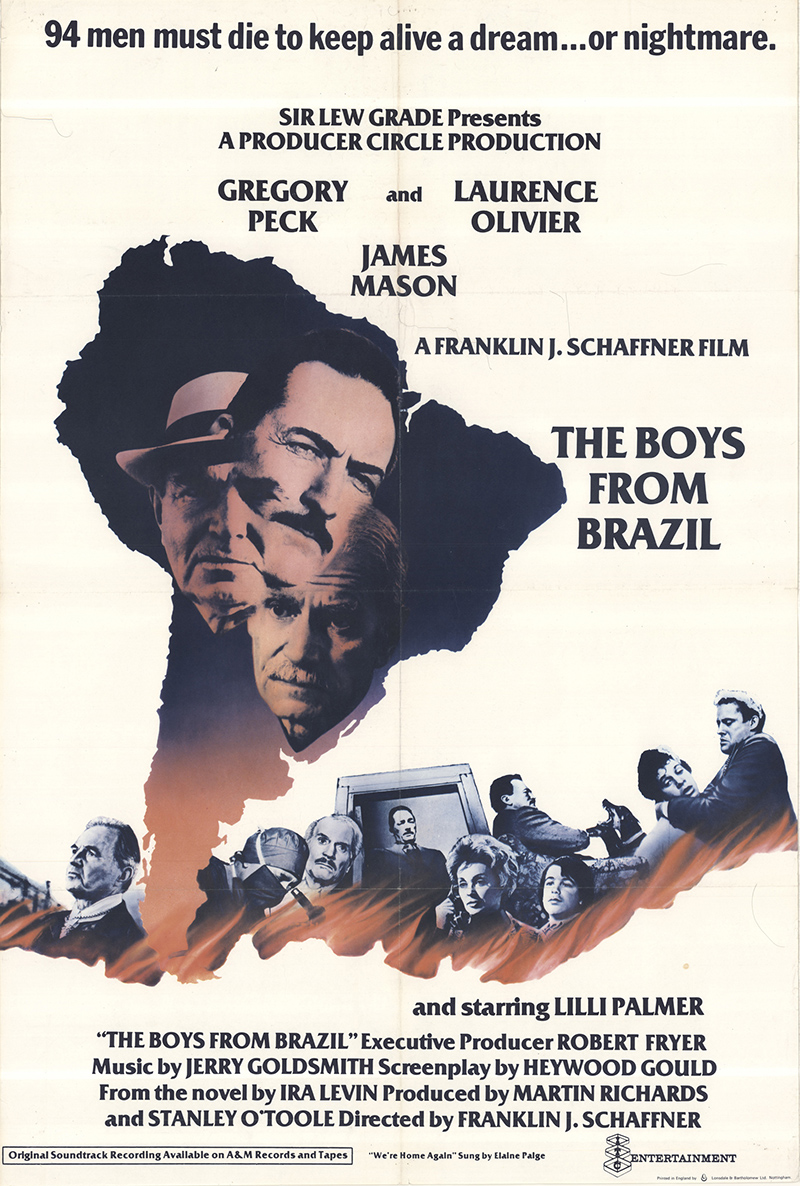
The Long Dark Marathon of the Soul 2015: The Boys from Brazil (1978), directed by Franklin J. Schaffner

and


     Vampires are cool, ghosts can be spooky, but when you really want to get a monstrous antagonist with some staying power, it’s hard to go wrong with the Nazis. The quasi-mysticism, the self-destructive ideology, the appalling bigotry, and their sleek aesthetic design gives them visual appeal; They’re responsible for the deaths of over 10 million people and took control over most of Europe, but they also got their asses kicked hard, so they’re threatening but not so overtly strong that the protagonists don’t have a chance. Sure, the fact that our pop culture profits off of a government known for burning hundreds of people alive in massive ovens may seem in bad taste, but that’s exactly what makes them so alluring as villains. Nazis are the universal evil, no other political party or military force in human history have the same level name recognition and body count attributed to their actions, and because they’re such a figure of that which we consider ‘evil’ in this world, they have transcended historical record and become archetypes, which we can mold and adapt to fit our desires. They can be goofy, they can be all-powerful, they can be wizards, they can be super-scientists, they can be super villains, and sometimes (in certain circumstances) they can even be sympathetic. What Nazism actually represented is oftentimes obscured by their oversaturated presence in pop culture, and that’s something that should never happen, but I think there’s a certain poetic justice in the culmination of Hitler’s vision being reduced to the level of Chuckie or the Gingerdead Man.

     Although not quite at that level of B-movie boogeyman, the Nazis are indeed the bad guys in Franklin J. Schaffner’s The Boys From Brazil, released through 20th Century Fox. It’s the late 70s, and from all accounts the remnants of the former Nazi Party are gathering themselves together in Paraguay (South America being totally okay with sheltering people who would actively work towards seeing them eradicated, which you would think they’d be against). It seems that Dr. Josef Mengele, the infamous Angel of Death, is at the head of a clandestine plan involving the murder of 65 year old civil servants across the Western world and maybe, just maybe, the pseudoscientific resurrection of a certain mustachioed lunatic despot. The only hope our world has seems to rest on the shoulders of one Ezra Liebermann, a Nazi hunter from the days of old. Can he put the pieces together and stop the Nazis and their insane plans once and for all? Well, it’s the Nazis, so that should tell you something right there.

     Putting aside the now outdated ideas about biology that exists as the crux of the story, suspension of disbelief and all that, The Boys From Brazil is a movie that really really relies on the strength of its two main actors: the legendary Laurence Olivier as Ezra Liebermann and the equally amazing Gregory Peck as Josef Mengele. Peck’s Mengele is arguably the driving force of the movie, combining a vampiric charm with the dogmatic mania commonly attributed with Nazism. Olivier, while perhaps dipping too deeply into stereotypes, is the understated, meek foil to Peck’s commanding presence. Unfortunately none of the other characters really have as much of a presence (especially not the Hitlers), which makes the wait time before the inevitable seem far longer than it already. I guess the fact we even want to see that confrontation is a good sign though.

     The Boys From Brazil is a little bit too long for its own good, and for a thriller movie there is a noticeable lack of action. Seeing two great actors together on the silver screen is a treat though, and seeing Peck go full on Triumph of the Will is entertaining when he really gets to chew the scenery. If you just got done watching some Indiana Jones movies this Halloween and you needed another movie where the Nazis fail like they always do, you could do worse than this. It’s got all the douchebag Hitler tweens you could ever want.

The Long Dark Marathon of the Soul '26: Cujo (1983), directed by Lewis Teague

  The Trailer and The Appropriate Tune - "Get At Me Dog", by DMX       We haven’t gotten our dose of Stephen King yet this year an...