Showing posts with label Stephen King. Show all posts

Tuesday, October 4, 2022

The Long Dark Marathon of the Soul 2022: Stand By Me (1986), directed by Rob Reiner


and

The Appropriate Tune: 'Stand By Me' by John Lennon


       It would’ve been pretty ironic if the year I decided to do an all adaptation edition of the Marathon that I just didn’t have Stephen King, huh? Hilarious even. Good thing we didn’t do it then, because this is a mature, adult-oriented blog dedicated to serious film criticism. No jokes should be made, not even unintentionally, or this noble art would be forever tainted. So yet another Stephen King adaptation, but rather than doing something obvious like Lawnmower Man or The Langoliers, how about we cover something a little more obscure?


       Released in 1986, Stand By Me was directed by Rob Reiner, written by Bruce A Evans and Raynold Gideon and produced by Evans, Gideon and Andrew Scheinman through Act III Productions, based on the 1982 novella “The Body” by Stephen King. Gordie Lachance brings us to the town of Castle Rock, Oregon in the year 1959, when he (as played by Wil Wheaton) was 12 years old, and he and his buddies Chris (River Phoenix), Teddy (Corey Feldman) and Verne (Jerry O’Connell) whiled away the summer days before the big move to junior high. One day Verne arrives at the treehouse and reveals that he had overheard two teenage tough talk about discovering a body in the woods a town or so over while stealing a car, likely that of Ray Brower, a local boy who had recently gone missing. This news excites the boys -- if they were able to locate the body and subsequently report it to the authorities, they’d be hailed as heroes! So that’s exactly what they decide to do, gathering their supplies and making the long journey to the corpse of Ray Brower. A literal journey, with all its trials and tribulations, and one of self-discovery, over the course of one crazy weekend in the summer of 59.


       While nowadays the American 1950’s is almost universally reviled as a period of bigotry, violence and sterile social conformity (which it was, to be fair), in the 1980s the shine had not quite left the rose. Films like American Graffiti and Grease and TV shows like Happy Days had not quite faded from the public consciousness yet, and bands like The Stray Cats were able to find success on the charts thanks to the rise of MTV and the thorough pilfering of the Atomic Age aesthetic. Given that, and the comedic bent to Rob Reiner’s creative work up to this point, a potential viewer might assume that this would also be a comedic nostalgia trip, a prototypical edition of The Sandlot. Although Gordie’s recollection of that time is ultimately positive however and there are definitely moments of humor, it is also made clear that this is in spite of the abuse that the boys go via their parents, other adults, and teenagers like Ace and his gang. They were ‘free’ in a Peter Pan esque way that many kids today couldn’t fathom, able to smoke cigarettes and carry guns and walk around unfettered by the need for supervision, but they did so under an atmosphere of ugly craziness that would become the standard in the 1970’s. Even the soundtrack, filled with the hits of the day by Buddy Holly and The Chordettes, seems almost Lynchian in the way it juxtaposes the saccharine ideal with the harsh reality. All of which would seem to place Stand By Me firmly in the latter category, but I think Stephen King manages to capture the human element that is often dismissed in recreations of the period.


       Stand By Me then is a coming-of-age story in two forms: the literal journey to Ray Brower’s corpse, overcoming the trials and tribulations set before them and so establishing their independence, and the emotional journey where they are forced to confront the trauma in their lives. Such a story requires a strong cast to do it justice and that’s precisely what Rob Reiner did, putting together a cast of kids that I don’t think I’ve ever seen matched in subsequent kids movies. All four leads put in great work here, you can see why they all went on to have some degree of success in Hollywood later on, but I have to give the nod to River Phoenix here. He hadn’t even hit puberty and yet he had such an impressive command of the tragic core of the character; Wise beyond his years, playing the role of best friend, surrogate brother and mentor all at once, but at the end of the day he’s still just a kid, and so those moments when he does show vulnerability, are all the more impactful because of it. So while Stand By Me is about Gordie dealing with the death of his brother, it’s about his relationship with Chris and how vital our bonds with our friends can be, especially when we’re young. 


       As far as directing goes, Stand By Me is simple but effective. Reiner isn’t reinventing the wheel here, but what he does is very direct and evocative, which is what a story like Stand By Me calls for, dealing as it does with memory and the perspective of children. I especially like the train scene: a dangerous set piece in any other film, but from the perspective of children seems downright apocalyptic.


       Stand By Me easily gets the recommendation. Stephen King built his career on horror and the supernatural, and although the macabre premise of ‘children looking for a corpse’ would seem to fit right into his wheelhouse, his exploration of guilt, abusive relationships and its impact on developing minds proved he was more than a genre writer. Similarly Rob Reiner would cement his position in the upper echelon of directors of the period, a streak that would last all the way up the mid 90’s, when North would finally derail his momentum. Kiefer Sutherland also proved he could play a good psycho, which certainly came in handy when he would play a psycho years later on TV. So definitely a film worth putting on this Halloween, but maybe don’t try and pull a double feature with The Goonies or Monster Squad, else the emotional whiplash might hurt something fierce.

Saturday, October 16, 2021

The Long Dark Marathon of the Soul 2021: The Dead Zone (1983), directed by David Cronenberg


and

The Appropriate Tune - "The Future Freaks Me Out" by Motion City Soundtrack


       If you’ve ever needed a visual aid to distinguish between strong and weak directors, look no further than Stephen King. Just about everything that man has put down on a page and put on a screen, from good to the coke-fueled, whiskey-soaked worst, and so the real challenge for the filmmaker is in how well he manages to adapt the material. Christine is literally a movie about an evil car, and yet John Carpenter managed to make it into one of the better films of his career and the decade. Stand By Me is about a bunch of weirdo kids who want to look at a corpse, but Rob Reiner managed to make it the coming-of-age movie that all future coming-of-age movies aspire to be. Conversely, Cujo is about a mother and her kid being menaced by a rabid dog, which seems like a good foundation for a thriller, but you never hear anyone speak about it or its director Lewis Teague in the same way they talk about Kubrick and The Shining. You can point to differing levels of budget or studio interference for these films and that is reasonable to an extent, but at the end of the day it comes down to how well you use the tools you have available. 


       Conveniently our unofficial rule of one Stephen King adaptation a year coincides with our annual appearance by Mr. Body Horror himself, David Cronenberg. Over the years I’ve found myself increasingly unable to place Cronenberg on the Bell curve of directors; He’s certainly has a mind for the grotesque and the ability to project that in his films in a way that not many directors are willing to do, and if they are not as successfully at the box office. Despite that, I’ve often found myself mixed on the films as films rather than just special effects showcases. Scanners was cool but the protagonist was a walking plank of wood, Crash was interesting but often like a porno on Ambien, and for a movie that involves performing oral sex with an open wound it felt like eXistenZ was constantly dragging its feet as it shuffled through the plot. I’m conflicted, so I’ve decided to take my own advice and see how one of one of the big names of 80s horror films tackles the material of one of the big names of 80’s horror literature. No, not Clive Barker, even though that seems like the obvious pairing, the other one.


       Released in 1983 (the same year as Videodrome), The Dead Zone was written by Jeffrey Boam, directed by David Cronenberg and produced by Debra Hill through the Dino De Laurentiis Company, based on the novel of the same name by Stephen King. Christopher Walken plays Johnny Smith, a respected English teacher and beloved boyfriend who one night collides into the side of a runaway milk truck. Five years later he awakes to find that the life he once knew is gone. Not only has he lost his teaching position but his girlfriend Sara (Brooke Adams) as well, who is now married to some guy who isn’t Christopher Walken and even has a kid. Coupled with this great loss however Johnny has somehow been granted an interesting gift: he is now psychic, able to see into a person’s past, present, and future with only a touch of their hand. Of course when you just woke up to find your entire life in pieces  the idea of playing Miss Cleo to every Tom, Dick and Harry off the street is the furthest thing, but as Johnny’s powers grow they cry out to be used, and no matter what he seems to do he keeps getting dragged into action. Which is the sort of behaviour that can get you in a lot of hot water, especially when Greg Stillson (Martin Sheen) enters the picture, a man with his eyes on the Senate and more than a few skeletons in his closet.


       As a story, The Dead Zone has a clear through-line of influence that traces back to the speculative fiction of Ray Bradbury, Rod Serling and the like. It presents us with a simple question: if you had the power to effect change, and you were the only one who could do it, would you do it in spite of the consequences? Does great power indeed come with great responsibility? For Stephen King, the answer is yes. After the accident ruins his life Johnny has little incentive to use his powers to help anyone; Indeed, Johnny is outright punished for using his powers throughout the course of the film beyond just being a social pariah, and yet each time he is confronted with the choice he chooses to help because he is fundamentally a good person. King’s choice to name his character ‘John Smith’, one of the most generic names in the book, was no accident; It was him saying that everyone had the potential to do what was right. Not too bad for the guy who wrote a story about an evil car.


       As an adaptation of the story though, I found The Dead Zone to be...simple I guess is close enough. It says what it needs to say to get the point across, sure, although perhaps in the truncated way that some adaptations do where it constantly feels like you’re missing half the book, but that’s where it stops. Were it not for the cast and the run time this feels more like an episode of Ray Bradbury Theater or the 90s Outer Limits than a multi-million dollar film. Spectacle for spectacle’s sake isn’t all that appealing, but we’re talking about David Cronenberg here. This is a filmmaker whose interests lie in the grotesque; Psychological extremes, sexual extremes, visual extremes in the case of his body horror, and yet everything about The Dead Zone feels by-the-books. Even when we get to the part of the film dealing with the Castle Rock Killer, something that sounds right up Cronenberg’s alley, it feels incredibly tame by his standards. Perhaps after the one-two punch of Scanners and Videodrome this was meant to be his big break movie, and he decided or was told to soften his tone to make it more accessible, but if that was the case I don’t think it was as successful as when the push was given to David Lynch or Paul Verhoeven. Or maybe I’ve just seen the big Cronenberg movies and I expect all of them to be weird as shit, who can say?


       I’m also not sure that the choice to cast Christopher Walken in the lead role was the best one. While Walken is a fine actor, even when he is a parody of himself, he lacks that quiet, everyman quality that the role calls for. He’s too intense; Every time he interacts with another human being it feels like he’s three seconds away from caving their skull in with a hammer, and setting him against the beautiful Brooke Adams doesn’t help assuage that feeling. On the other hand Martin Sheen is perfect as the boisterous, egomaniacal Greg Stillson, and the contrast between the apple pie eating, flag-waving patriot and this lumbering vampire is great visual storytelling. 


       While The Dead Zone is definitely not the flashiest movie of Cronenberg’s career (although the acting alone puts this over Scanners), he still put together an enjoyable film, and in terms of King adaptations that actually places it close to the top. The Dead Zone gets the recommendation; Perhaps not your first choice when you’re looking for genre films, but nevertheless a solid. And yes, there was a Dead Zone TV show a while back that made Johnny into a psychic detective playing around with the local cops solving crime, even though that cheapens everything about Johnny’s decision to help catch the Castle Rock Killer and the toll using his powers cost him physically and spiritually. Might as well just watch Psych instead.

Thursday, October 15, 2020

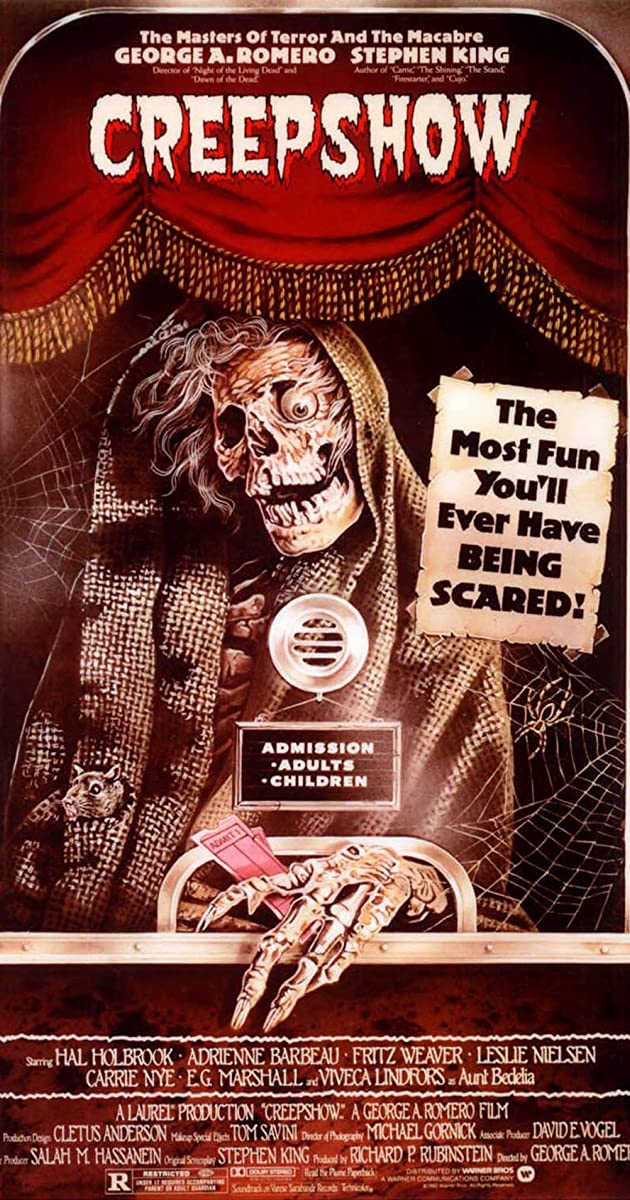
The Long Dark Marathon of the Soul 2020: Creepshow (1982), directed by George A. Romero


and

The Appropriate Tune: "Creep", by TLC


      We might have touched upon this before, but in spite of superheros being around since the inception of comic books, they were not always the sole interest of the medium. Indeed, there was a time not too long after what is called the ‘Golden Age’ of comics that superheros were barely worth the cheap paper it took to print them, and newspaper stands (back when they were still newspapers and comic books were still sold outside of comic shops) were packed instead with issues of Archie and Young Romance. Yet of all these other genre comics, the leader of the pack were the horror comics. House of Mystery, Vault of Horror, Chamber of Chills, these 4 color compilations of gruesome death and grisly murders in sharp detail shocked audiences across the country in the early 1950s, all the while raking in the cash. In fact they were too shocking: That whole ‘Seduction of the Innocent’ business, where that dude wrote a book about how Batman was trying to fuck Robin, wasn’t really about superheroes so much as it was about those horror comics, and so when comic companies adopted the Comics Code Authority in response horror comics kinda died off. You’d still see horror-based comics made afterwards of course, it’s not like the CCA was legally binding, but with this drive towards kid-friendly content came the introduction of the Silver Age, and that largely meant the financial end of anything that wasn’t wearing spandex or had magic alien powers. Or Uncle Scrooge I guess, people love that old fucking duck.


      While DC and Marvel had their own line of horror comics at the time, when talking about that period you have to mention EC Comics. EC was the home of Tales From the Crypt after all, which was revived as a film (which has been covered in a previous Marathon) and later became its very own multi-media franchise. Beyond that though, their comics just hit differently than other comics of the time; They looked better, went farther, said more than other companies did at the time. Which is probably why they basically collapsed after the CCA thing, but it’s that drive beyond simply selling funny books that can often resonate with readers. Perhaps even inspire someone to make a movie some thirty odd years later, which would inspire some weirdo on the internet to write a review about a couple more decades after that. Funny how things work out sometimes.


      Released in 1982, Creepshow was directed by George A. Romero (who made a couple zombie movies I doubt anyone has heard of) with a screenplay by horror maestro Stephen King, thus fulfilling our anthology and based-on-a-novel-by-Stephen-King movie quotas for the year. With a framing device centered around the guy from Night of the Creeps beating a child over a comic book, we then get a glimpse of the horror within: “Father’s Day”, a tale of familiar abuse and baked goods; “The Lonesome Death of Jordy Verrill”, in which a bumbling farmer stumbles across a bizarre meteor; “Something to Tide You Over”, a story about sandy beaches and psychotic ex-husbands; “The Crate”, a narrative detailing marital problems and mysterious boxes under the stairs; Capping off with “They’re Creeping Up On You!”, where a rich asshole/paranoid germaphobe receives a six-legged surprise. Each tale is more grim and ghastly than the last, each one a dagger of terror ready to pierce your heart at a moment’s notice. What more could you expect from a Creepshow?


      When it comes to anthology movies I think a lot of stock is placed in how much they push the overall theme. Tales From the Hood featured stories that dealt with issues relevant to those from ‘the hood’, it featured characters from ‘the hood’, it featured music people listened to in ‘the hood’, everything in that movie was built around that central theme. Spirits of the Dead on the other hand was an adaptation of Poe stories, but other than that there wasn’t really anything that connected the stories together beyond that, and I doubt the directors would have been interested in doing that anyway. In the case of Creepshow the idea is that it is an EC  horror comic brought to life, and that’s exactly what it tries to replicate. Lots of color saturation, scene transitions made to look like the panel layout of a comic, even incorporating some animation to go the extra mile. If you have never read a horror comic from EC Comics before, Vault of Horror, Tales From the Crypt, what have you, then this movie does a great job at showing you what made those comics so popular in the first place. Which might make it one of the better comic book movies ever made, admittedly not a great feat, but they did it.


      Of course you can’t have a horror film, especially one based on EC Comics (we’re close to drinking game levels of repetition here) without some proper make-up and special effects, and we’re in luck, because getting George Romero behind the camera means we also get Tom Savini, gore extraordinaire. You’ve got decomposing corpses, horrific monsters, bodies getting ripped apart, and buckets and buckets of fake blood. Originally I was going to criticize it for being a little too on the nose, like they don’t even try to hide the fact that this is shit is happening to a rubber-faced mannequin rather than a human being, but upon reflection I’ve come around to it. In Romero’s Dead films it made sense to treat the gore more realistically because the world it took place in was meant to be taken seriously (in spite of the satirical elements), but Creepshow is a movie based around comics books from the 50s, so having things come across as a tad goofy makes sense in the context that Romero and company are dealing in. 


      If a movie directed by George Romero and written by Stephen King wasn’t enough for audiences in 1982 though, they did folks a favor by throwing recognizable names up on the marquee. Not as big as the cast for Twilight Zone: The Movie a year later, but not a bad haul if you’re a fan of cult films: Hal Holbrook, Adrienne Barbeau, Leslie Neilsen, Ted Danson, Fritz Weaver, Tom Atkins, Ed Harris, Stephen King himself, even the kid who played Billy ended up becoming famous author Joe Hill. The best surprise of the bunch personally was Leslie Neilsen, who plays the psychotic ex-husband Richard in “Tide”. I know that he spent the bulk of his career doing dramatic work before moving onto comedy with Airplane!, but it still feels like a treat to see him drop the zaniness and get serious. I also have yet to see anything that Fritz Weaver was in that I didn’t like, there’s just something about his gaunt features and imposing stage presence that draws my eye to him.


      Speaking of Twilight Zone: The Movie, a common complaint that appears with that movie is also one that could apply to Creepshow, which is the choices of stories that were covered. There’s no cogent examination on the nature of man and our place in the universe when it comes to Creepshow, it’s all ironic deaths which may or may not include a monster. Which isn’t a bad thing, in fact it’s a foundation of horror fiction, but it’s not until “Tide” that the film finds a good footing in that regard. “Father’s Day” goes for that shocker ending to draw you in but since I never had the time or inclination to care about the characters for that ending to really affect me. The second segment “The Lonesome Death of Jordy Verrill” ends strong, but mostly acts as Stephen King’s demo tape for Hee Haw. Had these two been spaced out I doubt there’d be an issue, but because they run right after the other it ends up grinding your gears. Not only thoughts of ‘man, is the entire movie going to be this ephemeral?’ running through your head, but ‘why didn’t they cut one of these out to beef up the other segments?’. Although the three main segments work well enough as they are, the fact that it is Stephen King writing the screenplay does lead to assumptions that the writing must be of a certain level of quality. I guess you could blame George a bit too, since he’s likely the one that organized the segments, but that doesn’t really factor into the stories the segments told, which is all King.


      As for the best segment, as I said I have a fondness for Leslie Neilsen and therefore I have a fondness for “Tide”, the inclusion of Ted Danson being the icing on the cake. “The Crate” is the most well-written; It has the set-up, the suspense, the gore, it’s allotted a certain amount of time and it fills it out expertly. “They’re Creeping Up On You” is pretty good as well, built around a solid performance by E.G. Marshall, but it pulled off something not too dissimilar to “Father’s Day” that soured the ending for me. If this story was adapted from an actual comic book, it literally felt like they tacked on a ‘this ain’t your daddy’s EC Comics!’ stinger at the end. I dunno, it might seem contradictory when I was just praising excessive 80’s gore effects a couple paragraphs up, but if the story you’re telling doesn’t have a place for it then don’t shoe-horn it in there for kicks.


      If you’re looking into anthology horror movies the first title out of my mouth is still going to be Tales From the Hood, but second place would go to Creepshow. While 80’s directors revisiting stuff from the 50s wasn’t exactly uncommon, in fact this film shares a release year with a rather famous remake by John Carpenter, to their credit Romero and King don’t try and reinvent the wheel, they just have fun with it. If you’re a fan of the Tales From the Crypt TV series from back in the day, Creepshow is the prototype of all that mess. Those who need their horror strictly business however, or who want to find out what all the Stephen King hype is about might want to look elsewhere. Maybe Locke & Key, now available on netflix?

Wednesday, October 17, 2018

The Long Dark Marathon of the Soul 2018: It (2017), directed by Andy Muschietti


     Well it wouldn’t feel quite right to cover a Clive Barker movie without covering his famous counterpart, Stephen King. The Monster from Maine has had a long relationship with the art of cinema and like all relationships that last that long it’s a complicated one. Tales that are fed into the adaptation machine don’t always come out as you might expect, and with as many of King’s stories being adapted the average quality is all over the place. From cinematic greats like The Shining (even if King didn’t like it himself) and Carrie to lesser gems like The Running Man to straight-up garbage like The Tommyknockers and Lawnmower Man, and everything in between. We see it to this day, with the relatively forgotten hulu series 11/22/63, the favorable reception to the new King-based television series Castle Rock and best-left-forgotten Dark Tower film, but the one that really grabbed people’s attention at the time, really got people thinking about Stephen King again, was a little film by the name of It. Which just so happens to be the film I’m looking at today. Funny how that happens, huh?

     Life is hard when you’re a kid. You’ve got to deal with bullies, puberty, managing your time between the pool and the arcade, and all other sorts of stuff. It’s even worse in Derry, the town built on tragedy and sports an amount of deaths 6 times the national average but is apparently not much of an issue. Parents are more on the abusive side, bullies are more on the psychopathic, and It seems like now children are getting into the habit of disappearing. Case in point: Our protagonist Bill’s little brother Georgie, who went out to play on a rainy day and never came home again. A tragic but all-too-common occurrence in the world, but Bill isn’t one to take the easy way out. Georgie couldn’t have just vanished off the face of the earth, he has to be somewhere. Something had to have happened to him, and Bill can’t rest until he figures out what.

     As it turns out, what happened to Georgie is directly connected to what has been going on in Derry since its founding. There is something living in this town, something monstrous and evil, and every 27 years It returns to kill, feeding off of the fear of the townsfolk, particularly young people, like some monstrous psychic parasite. No one seems to realize that It even exists until Bill and his friends, Eddie, Stanley, Ritchie, Ben, Mike and Beverly manage to put the pieces together, but by that point It knows that they know as well. With no one to rely on but themselves, it’s a race against time as Bill and the gang try to conquer their fears as well as the living blight that resides in the sewers. Can the power of friendship overcome Lovecraftian clowns? Maybe if this was an anime.

     It ‘17 is but another brick in the wall of films that predominantly feature kids and young adults in lead roles. It’s historically a make-or-break kind of thing, but the Marathon has covered several movies where younger actors have proven to be a boon rather than a detriment, like Monster Squad and City of Lost Children, and It ‘17 is no exception. In fact It might be the best of the bunch, as I think the whole cast nails It. Some characters, Stan and Mike in particular, end up getting shafted in terms of lines, but it’s less an issue with their acting and more with that abridged feeling that I mentioned earlier. Finn Wolfhard as Ritchie is the obvious highlight, Stranger Things lifts at least 50 percent of Its shit from Stephen King after all, but in terms of performances that would negatively impact the movie there’s no weak links.

     This is the second adaptation of King’s 1986 novel of course, the first being the famous 1990 miniseries that saw the great Tim Curry playing the role of Pennywise the Dancing Clown. As of this writing I’ve never seen the miniseries so I can’t make any side by side comparisons of the two. 2017’s It obviously the advantage of a couple decades of production advancements, however the 1990 miniseries is a complete entire story, whereas It ‘17 is only what is dubbed ‘Chapter One’. It tries to compensate for that with a two-hour plus runtime, but there’s the distinct impression that you’re seeing the abridged version of a story. As for the dual Pennywise, Bill Skarsgard seems a more an adequate replacement for Curry from what I can tell. More overtly monstrous, which might undercut the creepiness of having a clown crawling around in the sewers, but he gets the job done.

     However, that leads into my major issue with Stephen King, and thus with It ‘17: He’s not scary. Perhaps this is only an issue when It comes to adaptations of his work, but I’ve never felt anything beyond mildly chilled with a King story. I like the concepts, and in the hands of the right people the unique essence of King shines through, but they don’t produce the emotional response that I assume the author intended. Say what you will about Clive Barker’s filmography, and I have, but that scene in Hellraiser where the antagonist reformed his body from blood and viscera was an awesome scene as well as disgusting. Not so with King, except for maybe Misery. Misery is pretty creepy.

     So then we come to It ‘17, or as I like to call It the pretzel dark ride of horror, because every couple minutes or so you get a new spooky moment thrown at you. Yeah It looks cool, in fact there’s a lot of great little mindbenders in here, but It falls under the common modern horror trap of looking too clean and artificial and thus not truly scary. Not to knock on CGI too much, because I don’t know how much work It would take to do some of this stuff practically, but when It’s people interacting with something that’s clearly not there with them It screws up my suspension of disbelief a bit. Could also be that I’ve seen too many horror movies and have thus become jaded, so folks with a lower spoop tolerance will likely get a lot more out of It.

     Whether you end up scared or not, It is a well-made, entertaining movie, and it easily earns the recommendation. Throw this into a ‘modern day horror isn’t shitty after all’ double feature with Get Out this Halloween, or slot it into a much larger Stephen King marathon. Maybe do it dressed as a clown, I dunno. I’m not going to tell you how to spend your free time.

Monday, October 2, 2017

The Long Dark Marathon of the Soul 2017 - Christine (1983), directed by John Carpenter


     There’s an episode of Family Guy where, when asked about his next book by his publisher, Stephen King grabs a nearby lamp off of the desk and starts waving it around, claiming that it is a ‘haunted lamp’. I paraphrase of course, a Family Guy joke doesn’t really deserve any more than that, but the idea behind it is clear: Although Stephen King has written several stories of significant depth, like The Black Tower and The Stand, he also has a history of seemingly tossing out stories where normally mundane things end up murdering people. There’s a story where a dog murders people, one where a monkey kills people, a trucker kills people, a fangirl kills people and so on. A very simple formula and easily exploitable formula, which is where Family Guy’s ‘humor’ comes in, but one that works principally because King is someone who understands the art of suspense. Much like how Alan Moore turned a cheap British homage to Captain Marvel into the pioneer of modern comic storytelling, a talented enough writer can take any subject matter and turn it into something original and compelling. I think after years of being known as one of the most prolific authors of the modern age, King has more than proven that.

     The perception of Stephen King as the ‘haunted lamp’ guy most likely got its start with “Christine”, a 1983 novel of the pain of adolescence, obsession and love, and also about a car that kills people. Later that same year, no doubt inspired by the success of Brian de Palma’s adaptation of “Carrie” and Stanley Kubrick’s adaptation of “The Shining”, “Christine” was also transformed into a major motion picture. The director this time round? John Carpenter, who just a few years previous had reinvented the horror genre with Halloween, and reinvented it again with his remake of The Thing from Another World. A fantastic choice, not just because Carpenter is an amazing director, but because he obviously understood how to craft a great horror film, whether it was rather minimalist (Halloween) or effect-heavy (The Thing). Carpenter has already been praised many times on this blog, so there’s no need to blow any more smoke up his ass. Suffice to say, getting John Carpenter attached to your project in the early 80s was a good sign.

     Just as the novel “Christine” is a story of love, obsession and the pain of adolescence, so too is the film Christine. Specifically the pain of Arnie, the biggest nerd in Rockridge California, 1978. Abused by school bullies, lorded over by his parents, ignored by women, Arnie doesn’t have much going on in his life, until he comes across a very interesting car for sale by the name of Christine. Arnie takes an immediate liking to Christine, deciding to buy it and build it back up as good as new. At first this seems like a good thing, Arnie has become more cool and outspoken, he’s starting to attract attention from the opposite sex, but it all falls by the wayside because of Christine. Arnie is becoming obsessed with this car, devoting all of his time and attention to it, to the detriment of everything else. Thing is, seems like Christine might be just as possessive about Arnie, and she has a tendency to get a little more...physical to get her way.

     So yeah, a movie about a car that kills people. Ridiculous in theory, but this is John Carpenter we’re talking about, the man who kickstarted a multi-film franchise on the back of a character that never says a single word. When you see a guy walking down a street at night and those headlights pop on, that is prime A-grade level slasher material. A lot of killings themselves are kind of downplayed, which is certainly a shame, but I think they make up for it with the car violence. Much like Michael Myers, Christine is a single-minded murderer, and no matter how damaged she gets, she just fixes herself up and keeps on going (a relatively simple effect I imagine, but in my opinion an effective one). Seeing Christine ram into a wall at full speed, getting set on fire, ramming into other vehicles...Sure, we don’t get the gruesome details of seeing someone get turned into street pizza, but the visceral power of those scenes manage to be just as thrilling as seeing Jason Vorhees stabbing a guy with a machete. Like a demolition derby with great cinematography.

     Cast wise, it’s all pretty okay across the board. Dennis(played by John Stockwell) and Leigh (played by Alexandra Paul) seem a little flat for main characters, but Keith Gordon’s slow descent from lovable nerd Arnie to rebel psycho Arnie is done pretty well. This is also kind of weird, but I think Christine does old men characters really well for some reason. Will Darnell (Robert Prosky), George Lebay (Roberts Blossom), Rudy Junkins (Harry Dean Stanton) to a lesser extent, they’re such distinctive characters that your attention is drawn to them whenever they’re on screen. Is that another common theme in Stephen King’s writing? Entertaining old people? I honestly don’t know, but if Christine is any indication, I need to read more of his books.

     Music wise, we have a combination of a classic Carpenter soundtrack, minimalist synths, pulsing beats and so on and a collection of 50’s rock ‘n’ roll hits, which act as Christine’s method of communication. I also have to wonder whether there were many films before Christine where they take golden oldies style music, which typically invokes feelings of wistful nostalgia and simpler times, and subverts it to some degree. It’s a common theme now, the scene in Predator where Little Richard is playing over someone firing a minigun in a military camp, the later editions of the Fallout video game series, but I wonder if Christine is where that ball started rolling. As for the rest of the soundtrack, I love synths with a passion that borders on the strange, so a John Carpenter film rarely disappoints in that regard.

     Despite an absurd premise that’s stretched over a standard slasher-style framework, Christine is a fun movie. It looks great, it sounds amazing, it all runs like a well-oiled machine. Like an automobile, if you will. Those looking for a film that’s more suspenseful than outright scary, or have a passion for vintage cars will find this film right up their alley.

     You’ll never think about jay-walking the same way again.

The Long Dark Marathon of the Soul '26: Cujo (1983), directed by Lewis Teague

  The Trailer and The Appropriate Tune - "Get At Me Dog", by DMX       We haven’t gotten our dose of Stephen King yet this year an...