Thursday, October 22, 2015

The Long Dark Marathon of the Soul 2015: The Castle of Cagliostro (1979), directed by Hayao Miyazaki

and


     When it comes to animation, few names entail a level of respect and admiration like Hayao Miyazaki. In a market dominated by Disney and Dreamwork’s forever war, the work of Miyazaki and Studio Ghibli have been the outlier, one of the few to chip away at the saccharine stigma the U.S. has when it comes to animation, like his peers Don Bluth and Ralph Bakshi. Even more noteworthy, he is the only director of anime (or anime movies, to stop any naysayers) to hold any sort of regard in America. People who have never watched anime, maybe even shit talk it when asked, will often give a pass to Miyazaki’s films. That’s power my friends, more than any one of your Dragon Balls or Narutos.

     While he is generally known for his original works, like Spirited Away and My Neighbor Totoro, Miyazaki’s first major work was actually an adaptation of the popular Japanese comic Lupin III, which in anime terms generally means using the characters in original stories rather than taking something from the comics. Created by mangaka Monkey Punch in 1967 for the magazine Weekly Manga Action, Lupin III detailed the adventures of the titular character, Arsene Lupin III, the cocky, perverted descendant of the master thief Arsene Lupin (the French equivalent of Sherlock Holmes, sort of a proto-pulp hero). Alongside his team of reprobates: eagle eyed marksman Jigen, master swordsman Goemon and femme fatale Fujiko Mine, Lupin frequently engages in acts of high risk, high reward and high profile theft and espionage, always one step ahead of his arch-nemesis, Interpol Officer Zenigata. Manga gave way to a popular anime series, which eventually transitioned into a full-blown franchise with several films and OVAs to its credit. What Lupin eventually became may not exactly resemble Monkey Punch’s original series, but he’s still pretty awesome, and he’s carved himself a nice place in pop culture to boot. Japan’s very own crazy James Bond.

     The Castle of Cagliostro, though not an ‘original’ story, still carries that distinctive Miyazaki flair that we would come to know and love from his later films. While on a visit to the Duchy of Cagliostro, a tiny nation known in criminal circles as the counterfeiting capital of the world, Lupin and Jigen come to the aid of a runaway bride, on the run from shadowy goons. The bride, as it turns out, is Lady Clarice, the last surviving member of the royal family, and the goons are employed by the Count of Cagliostro, the current regent and huge asshole. Seems that there is a secret treasure connected to the royal rings, and by marrying Lady Clarice the Count gets to solidify his rule and get access to the treasure. It’s a job with little to gain and much to lose, considering the death traps, security systems and ninja guards, but the master thief just can’t sit idly by while there is a lady in need, can he? Add to that a chance to depose the ruler of a sovereign nation and create an international incident, and it’s like icing on the cake. Go big or go home, it’s the Lupin way.

     I don’t know what it is with Miyazaki’s films, but they always fill me with a sense of nostalgia. It’s the same with Cagliostro. It’s not about the bittersweet process of growing up like Kiki’s Delivery Service or Totoro, and yet in a way it kind of is. By 1979 Lupin the Third, Jigen and the others had already existed for over 10 years, characters which to a lot of people embodied the fun and seemingly endless days of their childhood. By taking those characters and placing them in a classic archetypal framework, the hero rescuing a princess from an evil ruler, Miyazaki is telling the audience a modern day fable, substituting characters like Robin Hood or Lancelot with Lupin and Jigen. It gives the film a timeless quality, and it imbues the characters with this sense of magic, this wonder that so often seems to leave us as we grow older. Yet that magic, the unshakeable belief that Lupin will always get away, that Zenigata will always chase him, it’s...comforting, I guess is the way to describe it. Comforting to think that, like with Indiana Jones or the original Star Wars, the world was this amazing exciting place, and that heroes really did exist and adventure was always around the corner. That’s the world I want to live in, and that’s the world that has been taken from me over the years, to be replaced with this ugly cancerous cynicism about politics and the environment and life. I hate it, I honestly fucking hate it. But when I watch this movie, when I watch any Miyazaki movie, I get to remember what it was like, and live in that moment for a while.

     Halloween is a holiday all about remembering that feeling, I think. Like the rest of these movies though, it’s just an excuse to watch something I haven’t seen, so decide for yourself whether it fits your criteria. Either way, it’s recommended.

Wednesday, October 21, 2015

The Long Dark Marathon of the Soul 2015: Pitch Black (2000), directed by David Twohy

and


     What would happen if you took a little bit of Alien, a splash of The Descent, a pinch of Cube and threw in a (at the time) B-grade actor in the lead role? Why you’d get Pitch Black of course, produced by Interscope Communications and Polygram Filmed Entertainment and starring Vin Diesel as the gruff anti-hero Riddick. This was the starting point of the Riddick franchise actually, which spawned three sequels and at least one video game, Escape from Butcher Bay, the quality of which may vary depending on who you ask. Considering the amount of money he makes on each Fast & Furious movie, he can probably afford to do whatever fucking movie he wants.

     When a routine space transport ends in an emergency crash landing, a motley crew of survivors are stranded on a desert world, a harsh planet where its three suns keep it locked in perpetual day. Even worse, one of the survivors is Riddick, a known murderer who was being transferred to the authorities before the crash. Even more worse, it seems that there is life on this planet, life that shuns the light but has a taste for human flesh in all its forms. And the worst news of all? The planet is right on the verge of its months long eclipse cycle. It’s about to get real dark real quick, and this ragtag bunch of misfits are going to have to work together in order to make it off this planet alive. Of course this is a horror movie, so you know some gorey death is coming.

     Once again, not a movie that really blows me away story. You’ve seen the same setup and the same archetypes (in some situations, maybe even the same setups) in any syfy TV movie that you’ve ever seen, though I don’t know why you would. Most of the selling point comes in the artistic design/special effects and in the character of Riddick, who was apparently popular enough to warrant a franchise built from him. Pitch Black does look good, in a dirty Star Wars/Firefly kind of way, and Riddick is the gruff Wolverine style antihero that teenage boys froth at the mouth over, so I can see where the cult following comes from. It’s not mindblowing in any way, but it is an entertaining film with a cool concept, and that’s what Halloween is all about. Recommended.

Tuesday, October 20, 2015

The Long Dark Marathon of the Soul 2015: The Matrix (1999), directed by The Wachowskis

and


     Although time, a series of disappointing sequels and whatever the Wachowski’s were smoking when they made Jupiter Ascending has diminished its legacy somewhat, one cannot overstate the importance The Matrix had on the film industry. Just as Star Wars and Raiders reinvented the adventure movie, and Alien and Blade Runner redefined science fiction, it was The Matrix that really informed how action movies were made afterward. If you ever got annoyed of the preponderance of white guy karate or unnecessary slow motion (looking at you Watchmen, you piece of shit) in today’s action films, a little of the blame has to go to the Wachowskis, but at the time it was revolutionary. Huge martial arts fights straight out of your favorite animes, mind-bending special effects, and a concept that instantly grabbed the minds of the moviegoing audience, paranoid schizophrenic and otherwise. Cyberpunk may have already been an established literary genre, and cyberpunk stories may have already been adapted to film before, but when The Matrix came along, with it’s level of scale and technical polish, it was the only girl in the room. And this lady loves black leather.

     That being said, this is a movie that lives and dies by its action scenes. While the concept of the Matrix, that life as we know it is actually a computer simulation run by an advanced A.I. that almost all of humanity is trapped in, is fantastic and raises a lot of question about the nature of perception, the given purpose for the Matrix’s existence is rather silly and the story seems more interested in trying to replicate Star Wars’ quasi-mystical horseshit in a medium that doesn’t really need it. The characters are forgettable at best (aside from Laurence Fishburne and Hugo Weaving, who really bring it home), especially Keanu ‘Am I Watching Techno-Jesus or the Board He Was Nailed To’ Reeves, who seems to be taking the approach that you’ll never be able to tell who’s a human and who’s a machine when he’s around. A distinction which seems to revolve around constantly dropping koans like we’re a fucking Shaolin temple. Yes Matrix, we get it: they’re big into prophecies and mess with reality all the time, and so you expect a bit of ‘these characters know what’s up but can’t just say it for whatever reason’, but does the dialogue have to constantly dip into this vague nonsense that tries to sound deep in the moment but isn’t saying anything at all? Maybe if I felt Neo were absorbing this information, learning from it like some cyber-bodhisattva and gradually getting better, but Neo seems even more clueless than we are, and his sudden ascension to computer god in the third act seems like a leap considering he was some Office Space desk jockey living in a pod a day ago. It seems like something that would really grab you when you were an impressionable teen (which I wasn’t at the time of release), but once you get older you really notice the plasticity of the whole thing.

     That also being said, a lot of those problems can be forgiven due to the sheer fact that this movie is exciting. Not just with the slo-mo and dodging bullet stuff, your mileage may vary on that, but every fight scene, every shoot-out, every chase seems to radiate this frenetic energy that draws you into the action, which seems like another facet of The Matrix that has wormed its way into modern filmmaking. Say what you will about the plot of any Wachowski product, as I demonstrated earlier they’re not story-driven directors, but in terms of visuals and artistic design they’re definitely above the norm. You may not get why the machines keep people in pods or why Cipher is a total shitlord, but to see it play out (especially on a big screen) is fascinating.to behold.

     Like drinking a glass of expensive scotch, it’s a totally smooth.experience.

     Which is why I recommend watching The Matrix at least once, if you’re a fan of action films or science fiction, likely a large crossover appeal. As ridiculous as it can be and essentially is, it’s nevertheless a cool movie. Dare I say it, a fun movie, one to drink a cold beer to with a selection of friends and loved ones. So I have no problem recommending it to you this Halloween, where that situation is very likely to play out. I’d avoid it if there are kids around however, that cyber-silverfish scene freaked me the fuck out back then.

Monday, October 19, 2015

The Long Dark Marathon of the Soul 2015: The Rocketeer (1991), directed by Joe Johnston

and


     This might be surprising to some of you movie fans out there, but there was a time when comic book movies existed that weren’t connected to Marvel or DC at all. It’s true, after the explosive success of Tim Burton’s Batman in 1989 showed Hollywood that maybe there was some money to be made in these funny book things, suddenly we started seeing more and more of them popping up in movie theaters. Teenage Mutant Ninja Turtles, The Crow, Spawn, Men in Black, The Mask, Guyver, The Shadow and later on movies like Hellboy and From Hell, a sizable portion of comic book adaptations from less mainstream sources, while DC was running the Bat gauntlet and Marvel was tossing properties off the boat in a desperate attempt to stave off bankruptcy. Some of them may not be well-regarded these days, hell most people probably don’t even realize some of these films were comics at all, and only a couple could be said to have earned enough money to be considered successful, but the fact that they were made at all is a testament to corporate Hollywood’s drunken stumbling towards the next big thing actually working out for the better.

     In the early 90s Disney was looking to get some of that sweet dosh as well, and to that end they optioned the rights for and subsequently released The Rocketeer, based on the indie comic by Dave Stephens. A golden age adventure taking cues from the Commando Cody film serials of the early 50s, Doc Savage, and proto-dieselpunk sensibilities, The Rocketeer centers around the life of Cliff Secord, a down on his luck (yet with movie star good looks) stunt pilot that comes across a jet pack developed by aviation mogul Howard Hughes. What seems to be a boon to Secord and his ragtag airfield soon proves to be a burden, as the mob (under orders from famous actor Neville Sinclair, played by Timothy ‘Muh-Fuckin’ 007’ Dalton) threaten to tear apart his life and that of his naive actress girlfriend Jenny (Jennifer Connelly). Seems that this town is in need of a hero, and with the aid of Howard Hughes’ jet pack and a fancy new costume, Cliff Secord just might be that hero. He might just be...The Rocketeer. Coming this summer.

     Plus this is a movie set during WW2, so you know what fascistic military force is going to make an appearance.

     The Rocketeer doesn’t really make any turns you don’t expect, and being a movie with the Disney label on it, you can’t really expect it to move far beyond that ‘fun for the whole family’ labeling, but as these things go it’s a decent action/adventure movie. Personally I have a fondness for those movies that kind of idealize and even cartoonize that era of American history, Who Framed Roger Rabbit?, Dick Tracy, etc., and Rocketeer manages to scratch that art deco itch for mobsters and Ford Packards while managing to be entertaining throughout. It could have leaned a bit more heavily into the action and Rocketeering side of things, there’s a lot more talking about the jet pack than actually using it for my liking, but it is what it is. I’m sure some of you out there have kids, so if you need a movie this Halloween that’s not spooky but still has the essence of sci-fi and nerdiness that has come to define the holiday, pop in The Rocketeer and see how it goes. Who knows, you might plant the seed of nerd in their heads on the spot.

Sunday, October 18, 2015

The Long Dark Marathon of the Soul 2015: The Babadook (2014), directed by Jennifer Kent

and


     When you’re a single mother suffering from PTSD with an annoying brat of a kid living in a world where most people you know treat you like shit, how could life possibly get any worse? That’s easy, by throwing in some murderous supernatural creature of course! Which is exactly what we get with The Babadook here. The Babadook being some sort of insectoid boogeyman that comes from a storybook that apparently possesses parents and compels them to murder their children, I guess? It’s both simplistic and very vague on that front.

     I’m sorry folks, I really can’t bring myself to write about this one. I’ll admit, it does get a bit creepy by the midway point, and the overall concept (a twist on The Omen and The Exorcist where it’s the parent in trouble rather than the child) is interesting, movie really killed off any enthusiasm I had to write an article. I couldn’t stand the mother character, I couldn’t stand the screaming ADD-addled child character, I couldn’t stand the bitchy sister that exists for maybe 10 minutes, or really any other character in the film, which is a problem in a genre built on empathizing with character’s plights. The pacing seemed way too frenetic, like the director had to hard cut before we lingered on any one scene to much and any emotional resonance was formed. Not that it ends on a satisfying note anyway, or a way that’s even coherent, so I guess that doesn’t matter. Is it real? Is it a dream? Who gives a shit, it’s Babadook.

     I’ll come out and say that I’ve never really cared for modern horror movies, and maybe I was spoiled on enjoying it by the hype disease, so it could be that I’m coming from a place of bias. I dunno. Like I said before though, there is some good bits of tension and creepiness around the midway point, so those of you who haven’t been poisoned by hype will probably find something worthwhile here. It’s on netflix as of this writing, so if you’re one of those people who love to binge watch things on streaming platforms, you might try throwing this on your schedule. It’s better than reading a book.

Saturday, October 17, 2015

The Long Dark Marathon of the Soul 2015: Dredd (2012), directed by Pete Travis

and


     When people think about comics, they’ll generally think of DC/Marvel, or occasionally a manga series like One Piece and Jojo’s Bizarre Adventure. It makes sense - after all, the U.S. is currently in the grips of a multi-billion dollar Superhero Franchise War, and manga, while perhaps not as strong as it once was, is still a popular niche market. Hell, I wouldn’t be surprised if most people didn’t know the rest of the world even had comics, let alone its own unique and interesting superheroes and franchises. Did people watching that Tintin movie a few years realize it’s an extremely popular series from Belgium? Or that the Smurfs, which Hollywood recently exploited for a quick buck, was also of Belgian origin? We’d be surprised at just how global our lives really are nowadays, if we bothered to pay attention.

     In the U.K., some of the most well-respected comics in the country (and the world, if you’re one of those people who give a shit about comics) come from a science fiction anthology comic called 2000 AD. Founded on Feb. 26, 1977, collective series of 2000 AD often trended towards the fantastical side of ‘sci-fi’, with a level of violence, cynicism and satirical political commentary that had only really been touched upon by independent comic artists like Dave Sim and R. Crumb here in the States. Strontium Dogs, Rogue Trooper, Nemesis the Warlock, Indigo Prime, Nikolai Dante, the re-imagined Dan Dare, comics that made Batman and Spider-Man seem realistic in comparison, and by that token weren’t afraid to be comics and go off in weird directions. Having the likes of Alan Moore, Dave Gibbons, Grant Morrison and Kevin O’Neill amongst your contributors doesn’t hurt either.

     One of the earliest and easily the most popular characters to spring from the pages of 2000 AD was Judge Dredd, created by John Wagner. Taking place in a far-flung future, where nuclear war has reduced much of the Earth’s surface into an irradiated cinder and most of the Earth’s population are now concentrated into sprawling city-states known as Mega Cities, Judge Dredd follows the titular crimefighter himself, an elite member of the law enforcement/governing body known as the Judges, as he delivered swift and brutal justice to the lawbreakers of Mega City One. More a force of nature than a man, Dredd doesn’t take excuses, he doesn’t brook arguments and he doesn’t care about sob stories. If you break the law in Mega City One, then you’re going to get punished fo the fullest extent of the law, and Dredd won’t rest until you’re in handcuffs or in a bodybag. It doesn’t matter if you’re a robot, a chimpanzee gangster or a T-rex, all must answer to the Law.

     It is this hyper-rigid morality in a world of total excess that Pete Travis attempts to translate to film in his 2012 movie Dredd, the second film to be based on the British comic. A new drug called slow mo, which makes you see everything in bullet time, has hit the streets and Judge Dredd, the greatest of all Judges, is not a fan of illegal narcotics. After a very public triple homicide appears to link slow mo distribution to a habitation tower known as Peachtrees (the ghetto of Mega City One), Dredd and rookie Cassandra ‘I’m the audience surrogate, but also totally an attractive blonde psychic mutant’ Anderson decide to enter and take the drug dealers to task once and for all. Peachtrees is not all fun and games though, and when Magdalene Madrigal (head of the MaMa clan) locks down the tower, the two Judges find themselves strangers in a strange land, with an veritable army of goons out for their blood. They’ll have to use every bit of their training to make their way through the gauntlet, take out MaMa and her goons and stem the tide of slow mo once and for all. No one is above the Law, and Judge Dredd is here to prove it.

     There are two problems with Dredd that really stand out to me. The first is the look. If you didn’t know ahead of time that Dredd took place in the future, there’d be no way of telling it from any dirty, unimpressive desert town (so New Mexico). Compared to the Mega City One of the comics, which is this unbelievably huge, cyberpunk-before-cyberpunk metropolis, the MC1 of Dredd seems at most times to be disappointingly devoid of life and activity. Perhaps Travis was going for a more realistic take on the character, and of course faithfully recreating MC1 would be hell on the budget, but the problems with the design also pose problems for the film as a whole. Without the futuristic aesthetic of the comics, does Judge Dredd’s costume really make any sense? Does his super-pistol with four different concurrent ammo types? This Mega City One barely looks like it has running water, yet the technology is advanced enough to arm the Judges? It’s an unnecessary test of the suspension of disbelief for a movie that shouldn’t need it.

     The second problem? It’s not a satire, or at least the satirical portions don’t come often enough. Sure, the character of Judge Dredd is cool, but the whole point of him (in my opinion) is that he’s meant to be parodical. Never not ‘in uniform, perpetually sour demeanor, rarely if ever questions whether the laws he enforces are just or whether he punishments he sentences people to are exorbitant. The ultimate fascist, and likely what a lot of people envisioned the police to be like during the notoriously tense Thatcher years in Britain, or at least an idealized version. Yet the situations and enemies Dredd faces are so ridiculous, and the way he interacts with people is so over the top that it ends up being funny. The fact that Mega City One is essentially a police state, where the legal system is reduced to a one man job and human rights are treated as a privilege, and there still manages to be rampant crime is about as blatant as it gets. Like I said, there are hints of throughout the movie (the homeless guy scene springs to mind), but it never quite reaches the level of excess of the original comic. Another concession for the moviegoing audience, I suspect.

     Still, for what it is, Dredd is still a decent action movie. You get a lot of violence, you get a lot of witty one-liners, and there’s a smattering of implied sexual situations. Exactly what we all want in an action movie, I’d say, with a little sci-fi twist. So if you’re interested in a little dirty, bloody violence this Halloween, maybe a costume idea that won’t break the bank, then get a little bit of Dredd in your life. Just don’t break any laws to do it.

Friday, October 16, 2015

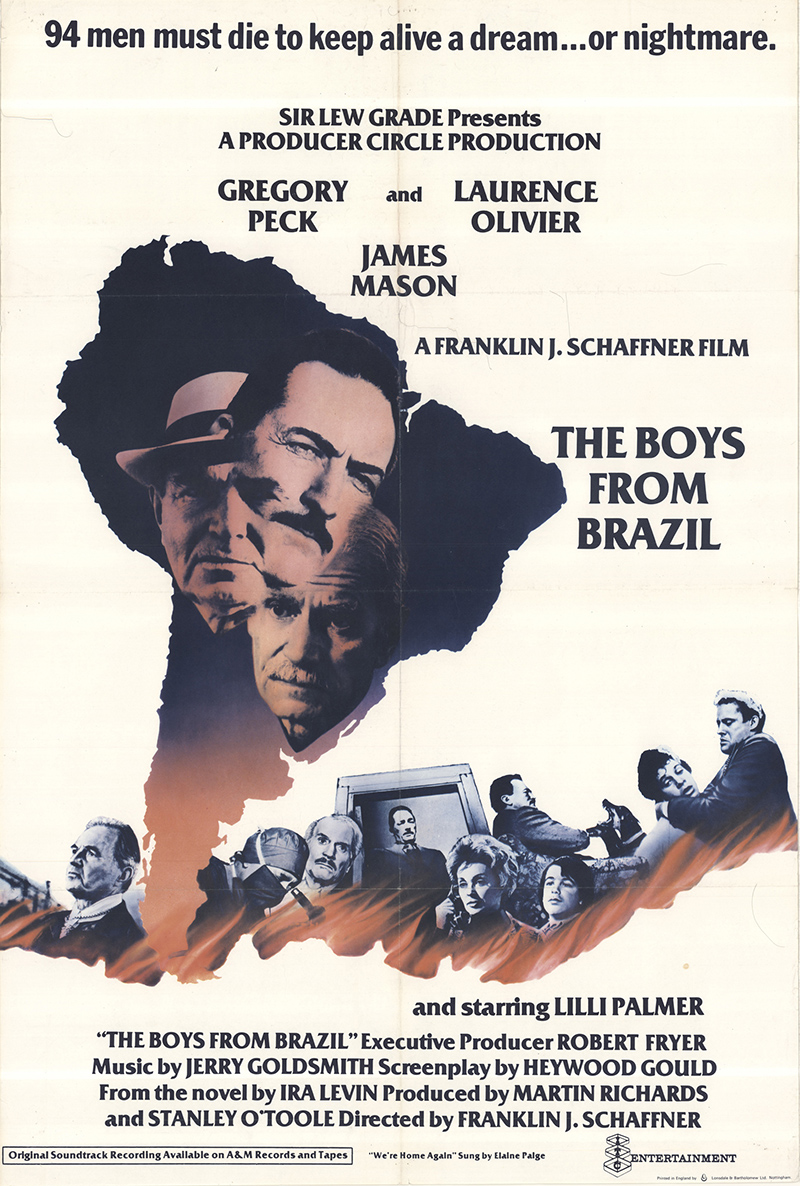
The Long Dark Marathon of the Soul 2015: The Boys from Brazil (1978), directed by Franklin J. Schaffner

and


     Vampires are cool, ghosts can be spooky, but when you really want to get a monstrous antagonist with some staying power, it’s hard to go wrong with the Nazis. The quasi-mysticism, the self-destructive ideology, the appalling bigotry, and their sleek aesthetic design gives them visual appeal; They’re responsible for the deaths of over 10 million people and took control over most of Europe, but they also got their asses kicked hard, so they’re threatening but not so overtly strong that the protagonists don’t have a chance. Sure, the fact that our pop culture profits off of a government known for burning hundreds of people alive in massive ovens may seem in bad taste, but that’s exactly what makes them so alluring as villains. Nazis are the universal evil, no other political party or military force in human history have the same level name recognition and body count attributed to their actions, and because they’re such a figure of that which we consider ‘evil’ in this world, they have transcended historical record and become archetypes, which we can mold and adapt to fit our desires. They can be goofy, they can be all-powerful, they can be wizards, they can be super-scientists, they can be super villains, and sometimes (in certain circumstances) they can even be sympathetic. What Nazism actually represented is oftentimes obscured by their oversaturated presence in pop culture, and that’s something that should never happen, but I think there’s a certain poetic justice in the culmination of Hitler’s vision being reduced to the level of Chuckie or the Gingerdead Man.

     Although not quite at that level of B-movie boogeyman, the Nazis are indeed the bad guys in Franklin J. Schaffner’s The Boys From Brazil, released through 20th Century Fox. It’s the late 70s, and from all accounts the remnants of the former Nazi Party are gathering themselves together in Paraguay (South America being totally okay with sheltering people who would actively work towards seeing them eradicated, which you would think they’d be against). It seems that Dr. Josef Mengele, the infamous Angel of Death, is at the head of a clandestine plan involving the murder of 65 year old civil servants across the Western world and maybe, just maybe, the pseudoscientific resurrection of a certain mustachioed lunatic despot. The only hope our world has seems to rest on the shoulders of one Ezra Liebermann, a Nazi hunter from the days of old. Can he put the pieces together and stop the Nazis and their insane plans once and for all? Well, it’s the Nazis, so that should tell you something right there.

     Putting aside the now outdated ideas about biology that exists as the crux of the story, suspension of disbelief and all that, The Boys From Brazil is a movie that really really relies on the strength of its two main actors: the legendary Laurence Olivier as Ezra Liebermann and the equally amazing Gregory Peck as Josef Mengele. Peck’s Mengele is arguably the driving force of the movie, combining a vampiric charm with the dogmatic mania commonly attributed with Nazism. Olivier, while perhaps dipping too deeply into stereotypes, is the understated, meek foil to Peck’s commanding presence. Unfortunately none of the other characters really have as much of a presence (especially not the Hitlers), which makes the wait time before the inevitable seem far longer than it already. I guess the fact we even want to see that confrontation is a good sign though.

     The Boys From Brazil is a little bit too long for its own good, and for a thriller movie there is a noticeable lack of action. Seeing two great actors together on the silver screen is a treat though, and seeing Peck go full on Triumph of the Will is entertaining when he really gets to chew the scenery. If you just got done watching some Indiana Jones movies this Halloween and you needed another movie where the Nazis fail like they always do, you could do worse than this. It’s got all the douchebag Hitler tweens you could ever want.

The Long Dark Marathon of the Soul '26: The Mothman Prophecies (2002), directed by Mark Pellington

  The Trailer and The Appropriate Tune - "Half Light", by Low   If you’ve ever been in the state of West Virginia, then you are re...