Thursday, October 3, 2019

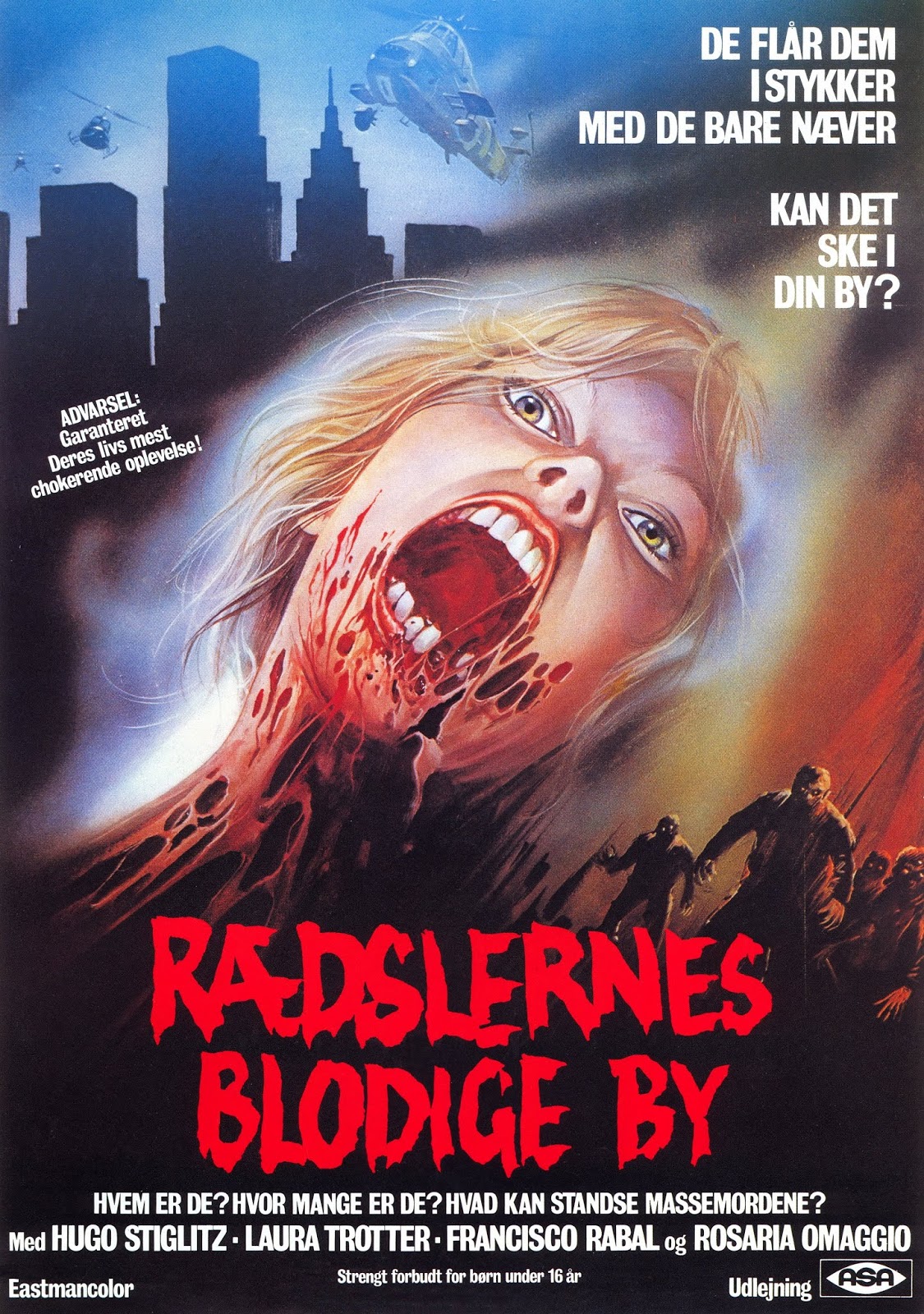
The Long Dark Marathon of the Soul 2019: Nightmare City (1980), directed by Umberto Lenzi

and

Second verse, same as the first.

Of all the monsters in movie history, none have become so tired and dull as the zombie. What things it was good for, social commentary, gorey special effects, have been done and what we’re left with is piles upon piles of cheaply made garbage that exists as nothing more than pornography that the folks from Doomsday Bunker use to satisfy their apocalypse fetish. If you’ve ever wondered why the Marathon hasn’t covered that many zombie movies over the years, that’s the reason why. Trash media that isn’t able to consistently elevate itself beyond that.

Today’s contestant that’s trying to prove the exception to the rule is Umberto Lenzi’s Nightmare City, or City of the Walking Dead as it was known in the US three years later. The film stars Hugo Stiglitz as Miller, a television reporter who is set to do a PR piece for a visiting professor investigating a radioactive leak at a nearby nuclear power plant, when a unidentified aircraft releases a plague of ghouls upon the city. Human in form, intelligent enough to operate machinery and firearms, but single-mindedly violent and with a hunger for blood. Which is enough for him to want to get out of dodge, but travel plans tend to go a little wonky when you’re in the middle of a zombie apocalypse. Or at least a bloodthirsty radioactive humanoid monster apocalypse, which is close enough.

While Nightmare City’s take on the zombie feels relatively unique, reminiscent of the brain-eaters of Return of the Living Dead, that’s about where my interest ends. The special effects are obviously not on the same level, and attempts at replicating the atmosphere of apocalyptic chaos and existential terror of something like Day of the Dead falls flat as there’s no strong character-driven moments to drive it. There’s Miller of course, but he doesn’t really have anything resembling an arc, and all the other characters we happen to follow are irrelevant to the story. So what we’re left with is about 90 minutes or so of zombies killing nameless people, people with names talking about things that lead nowhere with the occasional tit shot and I absolutely cannot care about any of it. A feeling that is only compounded with the big reveal at the end, which I won’t spoil, but will say is about as satisfying as being locked in an airtight room with a flatulent steer.

Which is why this review is so short and why, quote unquote regrettably, I can’t recommend Nightmare City. Those interested in the idea of Italian zombie movies will be better off looking into the work of Lucio Fulci, in particular his film Zombi 2, otherwise known as Zombie, Zombie Flesh Eaters or Island of the Living Dead. In terms of story and special effects that might just be the film for you this Halloween.

Wednesday, October 2, 2019

The Long Dark Marathon of the Soul 2019: Without Warning (1980), directed by Greydon Clark

and

       Of all the franchises that came screaming out of the womb that was the 1980’s, few are as beloved as Predator. Released in 1987 and directed by future Last Action Hero director John McTiernan, the original film told the story of a paramilitary death squad lead by ‘Dutch’ Schaefer engaged in shady and likely illegal activities in South America, who are stalked and killed by a mysterious and often invisible alien hunter that would eventually become known as a Predator. The film was a success, I think in large part due to it starring Arnold ‘biggest action star in the world’ Schwarzenegger and his glistening biceps, and so the legion of spin off material was unleashed upon the world. Comic books, video games and of course film sequels, including two crossovers with the Alien franchise. Not that any of it is all that good, even though I kind of liked Predator 2, but like many of the famous movie monsters of old it has mastered the art of coasting forever off of the strength of one film. I say famous, but really it’s any and all movie monsters that studios think will get them even one more dollar than they might have otherwise. Just look at the 7 Evil Bong movies.

Almost a decade before Predator, there was a film by the name of Without Warning which, perhaps not surprisingly, was also about a mysterious and often invisible alien who hunted humans. Directed by Greydon Clark and starring America’s favorite beef roast Jack Palance as Taylor the hunter/gas station and Martin Landau as psycho Vietnam vet Dobbs, Without Warning handles the premise in a more standard, slasher movie sort of way: A group of teenagers, looking to ignore obvious warning signs and have premarital sex, journey into a tiny backwoods town on a road trip and end up being hunted down by the aforementioned alien hunter. In the meantime we get to see a couple other deaths, and of course the girl who doesn’t have sex is allowed to live. If you’ve seen Friday the 13th or about a hundred other entries in the B-movie schlock genre.

Unlike Friday the 13th however, Without Warning has enough issues that I don’t believe it quite manages to rise above its lack of budget, cinematically speaking. The first 40 minutes of the film seems to take place in the same 25 feet of ugly what-I-presume-to-be marshland, and the rest of the locations are so far removed from context it’s hard to really tell where anything is in relation to each other. The acting aside from Palance and Landau is average at best and even then it feels like the two are trying to one-up each other in the crazy department. That, combined with some uneven audio quality and a plot that doesn’t want to leave the runway, makes that 40 minutes a pretty rough watch.

I will say that the ultimate reveal of the alien is probably the best scene of the film, almost Lynchian in a way, and director Greydon Clark makes the correct choice of only barely hinting at the alien’s true identity through shadows and lingering camera angles. How the alien kills his victims however, with little bloodsucking starfish-like creatures that spin through the air like frisbees, is ridiculous almost to the point of parody, and the fact that this is what we see for the majority of the film places it more in the league of something like Slugs or Frogs rather than Predator. They try to compensate for that by throwing in some POV shots, as if the alien is stalking its victims, but they can’t even keep that consistent. Hell, the first two of those POV shots are practically the same fucking bit of footage, neither of which feel like a hunter sneaking up on their prey but more like some B-roll they had lying around in case they needed to pad out the run time. Look at the first Friday the 13th, hell look at the Evil Dead films, and then try to look at this with a straight face. Won’t be easy, let me tell you.

Without Warning isn’t a bad film, and the folks of Fangoria magazine at the time certainly seemed taken with it, but with the benefit of hindsight it’s neither good nor bad enough to be truly memorable. The adventurous sci-fi/horror fans with a lot of free time on their hands out there might be intrigued enough at the idea of a proto-Predator movie to hunt it down, but everyone else will probably be fine just sticking with Predator. At least until they finally make that Archie vs. Predator movie we’ve all been asking for.

Tuesday, October 1, 2019

The Long Dark Marathon of the Soul 2019: Star Trek V: The Final Frontier (1989), directed by William Shatner

and

In the years since the Marathon first set its eyes to the heavens, the humble crew of the USS Enterprise has been on quite a number of wild adventures. They managed to reunite after almost a decade and meet a godlike being made out of a satellite, managed to stop a genetically altered superman from unleashing a doomsday weapon on the Earth, Spock died and managed to come back, the Enterprise blew up and came back, Kirk found out he had a son and then managed to ditch that potential story avenue pretty damn quick, and of course there was that time the Enterprise altered the fabric of time and space in order to steal some whales. For a crew that was assigned to a five year mission and only managed to complete three, it’s managed to have quite the staying power, thanks in large part to a loyal and dedicated fanbase. Now, 10 years after the first Star Trek film, 23 years after the premiere of the original series, and two years after the premiere of Star Trek: The Next Generation, there came another; A fifth film to rule them all, and in the darkness bind them. Or something like that, I mean science fiction and fantasy are basically the same thing anyway. 

       Set, as you would expect, after the events of Star Trek IV: The Voyage Home, Star Trek V: The Final Frontier sees the intrepid crew of the updated Federation starship Enterprise enjoying a bit of shore leave. Captain James T. Kirk, Spock, and Leonard McCoy are enjoying some camping and renditions of children’s song in Yosemite National Park, Scotty is attempting to get the ship up and running, Sulu and Chekov are lost in the woods, it’s just one big party. Their revelry is cut short however when an urgent command comes in from Starfleet about some business in the Neutral Zone. Apparently a group calling itself the Galactic Army of Light, headed by a mysterious Vulcan by the name of Sybok, has taken over the lone settlement of a planet named Nimbus III, a failed attempt at cooperation between the United Federation of Planets, the Klingon Empire and the Romulan Empire which is otherwise unremarkable aside from the fact that an ambassador of each faction is located there. Starfleet sends the Enterprise to investigate, and because the Klingons are very much into the idea of Kirk’s head on a pike they follow suit, but it seems that everyone is playing right into Sybok’s hands You see Sybok has a plan, the fulfillment of which could have life-changing effects for every sapient being in the galaxy, and to do that he’s going to need one Enterprise-shaped ship to do it. What could that plan be, and how does he recognize Spock?

        The Final Frontier was made on a significantly lower budget than the filmmakers had originally intended, which is quite obvious on a technical level. While the continuity is consistent enough, it looks and sounds like Star Trek, there are several bad camera angles, poor cinematography decisions and outright mistakes that a couple more reshoots and run throughs in the editing room might have corrected. This is quite evident in the depictions Klingons, who seem to be comprised of a mishmash of their now iconic cinematic redesigns and something that looks like it was ripped off of an episode of Blake’s 7. Oddly though this seems to be compensated for by plenty of shots of their ship, the Bird of Prey, and even some stop-motion work. In fact you get a more detailed look of the Bird of Prey than you do of the Enterprise, which exists more as a series of rooms than it does a starship. Rooms that accurately represent the aesthetic of Star Trek, but rooms nevertheless.

       The problem, then, must be with the story itself. Star Trek V sees Leonard Nimoy, who directed the previous two films, step down in favor of William Shatner, who also co-wrote the story. One wonders how Shatner, a man who has had a hand in creating several novels, Star Trek books and his very own science fiction series, TekWar, and who presumably has something to prove in this, his directorial debut, could create a film that renders him and his cast completely impotent. I don’t believe I’m exaggerating either, the majority of the crew doesn’t really do anything aside from Kirk and Spock, and they don’t really accomplish anything of significance. Not that there haven’t been episodes of the original Star Trek where the Enterprise was held hostage, but it’s never felt quite so...simple before. I mean this is a machine capable of moving faster than light crewed by a seasoned team of officers, and they’re rendered completely useless by some crusty dudes with guns. Not phasers mind you, but straight up guns. Hell, Sybok has a better claim to being protagonist of this story than the actual protagonists.

       This is no more evident than the way Star Trek V handles tone, or mishandles it as the case may be. What few moments of genuine characters moments there are, primarily the friendship between Kirk, Spock and McCoy, as well as a couple moments of unearned drama that are pulled out of the writer’s ass and tossed here and there across the script, is undercut by some truly abysmal attempts at comedy. Apparently Shatner saw how successful The Voyage Home was and decided that his film would have comedy in it too, without understanding why it was that the comedy in that film worked. It was silly seeing the Enterprise doing the Back to the Future culture shock thing yes, but it made sense in the context of the film and it was never so ridiculous that it felt like the filmmakers were insulting your intelligence. Not so with The Final Frontier. Case in point: There’s a scene where Scotty has just broken Kirk, Spock and McCoy out of the brig (which was also painfully unfunny but whatever), and they’re walking through some service tunnels. Kirk and the guys go one way, Scotty goes another, and almost immediately smacks his head on an overhang and knocks himself the fuck out, 3 Stooges style. Does this add anything to the plot, is Scotty being unconscious a major plot point that affects the outcome of the story? No, it’s a random bit of slapstick that only really serves to make Scotty look like a fucking idiot and to feel like Shatner attempting to haphazardly film around plot holes in his script rather than just writing a new one.

This ties into what I said a paragraph or so ago, but I don’t think William Shatner really understands what Star Trek is, or what made it great at all. I’m not the biggest fan of TOS, more of a TNG and DS9 guy personally, but as campy as that series could be it was understandable how and why James Kirk was such a popular character. He wasn’t just some space swashbuckler or strong-jawed cowboy, he was a man of intelligence, conviction and compassion who respected those who worked with him and was in turn respected by them. It was easy to understand how this man became a captain, and ultimately an admiral. In Star Trek V Kirk comes across mostly as a wise-cracking buffoon who is nonetheless treated to sycophantic comments like ‘failing you was worse (than endangering the safety of the Enterprise)’, and one who always manages to turn everyone’s focus towards himself. That is not James T. Kirk to me, that is William Shatner wanting the spotlight without having to work for it. Also, and this might seem extremely nerdy to some people, I don’t the Federation would allow a situation like Nimbus III to happen, with people living in abject poverty. Yeah it’s not exactly a perfect organization, and I could believe a joint diplomatic experiment between them, the Klingons and the Romulans (who never show up once in this entire movie for whatever reason) could fall apart, especially with Scotty’s overtly racist ‘Klingon devils’ comment at one point in the movie, but I cannot see them just dumping a bunch of people on a barren wasteland and leaving them to suffer. In the real world sure, but then the Star Trek world is better than ours in just about every way, so you expect them to act better..

       If you’ve ever heard that thing about the even numbered Star Trek films being better than the odd numbered ones, this is the one who invented it. Star Trek: The Motion Picture might not have been great, but at least it hit that classic science fiction beat of the universe being a mysterious place full of unknown wonders. Star Trek III: The Search for Spock might not have been great, but at least it tied up the loose ends from Wrath of Khan in a suitably dramatic way. Star Trek V: The Final Frontier, on the other hand, seems to be a toxic jambalaya of everything we’ve seen before, the cosmic wonder of TMP, the comedic nature of TVH, etc., a tone-deaf mess of sudden backstory and ill-timed attempts at levity that falls flat for Trekkers and non-Trekkers alike. It’s not Seduction of Dr. Fugazzi bad, if you’re one of those morbidly curious types, but if you’re going to skip any of the TOS Star Trek movies, then make it this one. You won’t be missing out on much, trust me.
Thursday, February 28, 2019

The Thunderbird Double Feature: Stanley Kubrick

       When I first started doing this blog I had always intended to avoid big names. Movies, directors, actors, what have you, I always wanted to keep at least a step or two out of the mainstream. So rather than doing the original Universal Frankenstein film for example, I did the relatively obscure Bride of Frankenstein, and when I felt like covering The Transformers I steered clear of anything resembling Michael Bay. The greats have already been talked about after all, the books have been written, the podcasts recorded, the blogs written, so what would throwing one more opinion on the pile really accomplish in the grand scheme of things? You had to get weird and obscure and cult, my mind told me, because that was where the action was, that was the way to get attention that I so desperately craved. Write about the movies that no one else is talking about and by default you gain a monopoly on the subject. For better or worse, I mean The attention my review of Ralph Bakshi’s Coonskin has gotten over the years has always made me feel a little paranoid.

Of course nothing ever lasts forever, and sooner or later some bigger and bigger names started creeping in. David Lynch, the Coen Brothers, John Carpenter, et cetera, I’ve grown such an obsession for film over the years, and since I rarely watch films anymore without reviewing them, I couldn’t help but dip my toes into that inviting water. Not that I thought that my worthless opinion would be the deciding factor in someone seeing Vertigo mind you, but that such historic films would provide a great backdrop for me to stretch the mind muscles a bit and work my way through a thought that I might not have a chance to otherwise. That’s why I write movie reviews in general I suppose, even if they’re shit and the only people who’ve read them are a couple of bots that hit the right string of key words in the search algorithm: It’s self-expression, just as painting a picture or performing a song is self-expression for someone else. I like writing and I like cinema, and it makes me happy to combine the two. Nuff said.

In the past I’ve used the Double Feature model to showcase some of those big names I’ve mentioned (and also the folks who made Dollman) and since it’s been so long since I’ve used it I figured it best to dust off the proverbial cobwebs with one of the biggest names of all: Stanley Kubrick, director of a good portion of the most iconic movies in American film history, making his debut appearance on this blog. Narrowing things down to just two was a bit of a hassle, but in the end it seemed appropriate to go with his very first feature film, 1953’s Fear and Desire, and his last (not including the stuff he did for A.I.), 1999’s Eyes Wide Shut. You can’t judge a decades long career on only two movies, like reading the first chapter of a book and then skipping to the last page, but I’m interested to see what, if anything, got its start in ‘53 and what managed to stick around until ‘99. Who knows, maybe I’ll unravel that vast web of conspiracies that Kubrick apparently shoved into all of his movies, if that documentary on The Shining is anything to go by. Who knows, maybe it’ll turn out that he staged the Moon landing after all. Guess I’ll see.


Fear and Desire (1953)
and

While his filmography technically begins two years earlier, with the short documentaries Day of the Flight and Flying Padre, Stanley Kubrick’s directorial debut truly began in 1953 with the film Fear and Desire. Set in a time and place removed from our own, yet still familiar, the film centers around a quartet of soldiers (Frank Silvera as ‘Mac’, Kenneth Harp as ‘Lt. Coby’, Paul Mazursky as ‘Sidney’ and Steve Coit as ‘Fletcher’) who have been stranded 6 miles behind enemy lines after their plane is shot down. With the pressure of being spotted by a passing aircraft constantly looming over their heads, the soldiers locate a nearby river and decide to build a raft in order to float across into home territory, only to discover a nearby enemy base and airstrip occupied by troops and a mysterious general. Mac wants to go after the general, Coby just wants to get the hell out of Dodge, but when it comes to war you’re never going to end up getting what you really want.

The story goes that Stanley Kubrick hated this movie, which he described as ‘boring and pretentious’, to such an extent that he actually tried to have all copies of it destroyed Star Wars Holiday Special-style. While that might seem a little extreme at first, I can see where he’s coming from to a certain degree. This was a man known for his obsessive perfectionist streak when it came to his craft after all, and Fear and Desire was a film made for around 50 grand and looked like it. The entire cast was made up of seven people (two of whom played dual roles) walking in what looks like about a hundred square feet of state park for about an hour set to music which sounds like it’s from an episode of Gunsmoke, spending whole scenes talking in internal monologues like it’s David Lynch’s Dune. That and some melodramatic flourishes, in particular when they finally introduce the general, does give off something of an ‘amateurish’ atmosphere. A college film project before the advent of college film classes if you will.

Which isn’t to say that’s a film without merit, or one worth destroying. I think the acting, while nothing extraordinary, is solid, with Frank Silvera (a year removed from his film debut) and future screenwriter and director Paul Mazursky (in his film debut) doing most of the heavy lifting. The music, during the moments when it is reduced from the usual bombast to a deep throbbing bass, is incredibly effective during the tense parts of the film. Ahead of its time in that regard you could say, going hand in hand with the overall tone of the film, which feels more at home with the existential dread of the Vietnam era than the Sgt. Rock flag-waving days of the 50s. These are not faceless avatars of patriotism, they are regular people who have been thrust into the meat grinder, where death awaits behind every corner, and their behavior reflects that. Confusion, indifference, a suicidal drive to prove oneself, and even a complete retreat into fantasy in the case of Sidney, it’s a straight line from what we see in Fear and Desire and what we would later see in Full Metal Jacket
  
It’s also just fun to see a young Kubrick experimenting behind the camera. His love of cutting to close shots of people’s eyes and faces, the way he plays with shadows during the scene with the general, the cutaways during the scene where the soldiers raid a cabin, it all feels like things Kubrick saw in other movies and wanted to try out for himself. Particularly silent era films, as it seems that there’s an emphasis on the visual. 

Fear and Desire is indeed a Stanley Kubrick film but the feeling of Kubrick, the essence of what has become known as Kubrick, is not quite there. The pieces don’t quite fit. Because of that I can’t say that Fear and Desire is a must-watch film, but it’s not a huge time investment and it’s impressive enough for a debut outing that it’s worth a watch if you’re in the mood.

Now let’s take a quick stroll around the wheel of time, about 46 years, and see where Stanley Kubrick ended up, with-

Eyes Wide Shut (1999)
and


12 years after the release of the release of the infamous Full Metal Jacket, and several years of projects that were never realized or incomplete (what would eventually become A.I.), Kubrick came out with what turned out to be his final film, 1999’s Eyes Wide Shut. Based on the novella “Traumnovelle” by Austrian writer Arthur Schnitzler, the film stars Tom Cruise (coming off his award-winning performance in Jerry Maguire) as Bill Hartford, a well-to-do doctor living in New York with his daughter Helena and wife Alice (Nicole Kidman). Things seem to be going well, until a bitter Alice recounts a story about her almost cheating on him with a sexy sailor. Disillusioned with himself and plagued with thoughts of Alice in the arms of another man, Bill heads off into the bowels of New York, a city where you can’t even throw a rock without someone trying to hump it. While chatting with an old med school chum, Bill by chance learns about a mysterious club where some supposedly super sexy shit is going down, and decides that he needs to get all up in there. Turns out that secret sex clubs aren’t all that happy about uninvited guests.

So like David Lynch’s Blue Velvet or David Cronenberg’s Crash, Stanley Kubrick’s Eyes Wide Shut is one of those erotic psycho-drama kinda films or perhaps more accurately a part of the ‘white guy discovers pornhub’ genre. Attractive white guy, predominantly rich, who somehow isn’t getting enough sex already get pulled into a seedy underworld of all that weird sex you’re always hearing about. In fact Eyes Wide Shut consciously or unconsciously takes a lot of cues from Lynch and Blue Velvet, what with some off of the off-filter performances, a score that (by Jocelyn Pook) that runs the gamut from isolating to menacing, and there is this attempt at an unsettling, surreal atmosphere that hangs over things, almost as if it were a dream. Which you can tell by all the times they beat you over the head talking about dreams.

       Compared to Blue Velvet or Crash however, Eyes Wide Shut unfortunately comes across as rather sedated. I mean you’ve got Tom Cruise in the lead role, a man who in 1999 was probably considered one of the most attractive men in Hollywood, and he doesn’t do anything. Of course a slow burn in a Kubrick is nothing to be surprised, but in Eyes Wide Shut it seems to be take to a whole new level. To put it bluntly, Tom Cruise’s character is one that doesn’t do anything, doesn’t accomplish anything, and after 2 and a half hours nothing about his life really changes. Even the mysterious sex club, the one part of the movie that has passed over into the popular culture, feels rather toothless in retrospect. I mean this is a guy who had a character blow his brains out with a shotgun in his last film, and the most he can think of for this shadowy clandestine meeting of the rich and powerful is some people wearing masks and having sex? Not weird sex, there’s no bathing in blood or goat sacrifices, the positions don’t go more exotic than Cowgirl, just some sex and a bunch of nudity (almost entirely from women, god forbid we even get the hint of a penis anywhere in the public sex scenes). Like who the hell cares? And if they’re really the major power-holders of the world, and they’re all masked, why would they be worried that some dude happened to sneak in? What’s he really gonna do, realistically speaking? Call the cops, and tell them ?

       Yeah, I already mentioned the references to dreams, so you might be able to forgive things being more metaphorical than realistic or things not adding up necessarily, but the movie is just dull. In Blue Velvet, you go hand in hand with Kyle Maclachlan's character as he gradually loses his innocence, in Crash, even though it’s rather boring as well, you get to see James Spader drag himself and others into this strange world, they are active participants in their stories. Which you could say is a bit of subtext on Kubrick’s part, that Alice’s dissatisfaction with Bill leads him to become ‘impotent’ in terms of his affect on events, but a movie isn’t built on subtext alone. Even if it were the case, you don’t need to take 239 minutes to say Tom Cruise got his dick wet. Most movies do that in half the time, easy.

Of course this is a Kubrick film, so the meat & potatoes part of the film, the guts of it, are excellent. Every scene, from the ritzy hotels of the wealthy to the dingy apartments of the poor, looks as if it were meticulously crafted, a mixture of reality and cinema just uneven to become noticeable. The prominent use of Dmitri Shostakovich’s Waltz No. 2 is also touch, as it’s a piece that I’ve always found to be both elegant and slightly foreboding, which fits in well with the ‘Great Gatsby’s sex life’ aesthetic that the film is going for. I also like that even 4 decades later there are some familiar elements from Fear and Desire here, shots emphasizing the face that cut to graphic scenes, the music stings, even a little internal voice clip like old Frank Silvera and the boys used to do. Stanley Kubrick seems to have a knack for crafting movies that could work just as well as a collection of paintings or photographs, and Eyes Wide Shut is no exception.

In the end however, whether it’s that oft-mentioned 2+ hour runtime or what, there’s just this...spark missing from Eyes Wide Shut for me. It feels like it should be a thriller, it feels like I should be on the edge of my seat in suspense, but it's not and I'm not. It’s not really a ‘bad’ movie though, the production is solid as I said and the cast is great, so I don’t feel as if I can just dismiss it as bad and say you shouldn’t watch it. So this is another one of those shitty, non-committal ‘play it by ear’ reviews then; If you’re interested, or you saw that one episode of Venture Bros. and you were curious then go for it, but if you’re looking for ‘the’ Stanley Kubrick film to watch, this ain’t gonna be it.

The first double feature in years, covering one of American cinema’s most famous filmmakers, and I end up covering two movies that I didn’t care for all that much. Somehow I’m not surprised. Even if he did make a couple of clunkers (in my opinion) though, there aren’t many people who had a strong an influence on the medium as Stanley Kubrick has had, even after his death. I mean when your style is so well known it’s become an adjective then you know you’re pretty big. I don’t know whether I’d like the man if I ever met him, reading about him ended up making me depressed, but above anything else the man was a craftsman, and I think he’d be pleased to hear that.

Friday, February 15, 2019

The Kentucky Fried Movie (1977), directed by John Landis

and


       If you ever needed proof of how pop culture’s tastes shift and change with the tides, look no further then the Zuckers. During the 1980s, what some nerds might call the renaissance period of American comedy films, David and Jerry Zucker (and Jim Abrahams) were responsible for what are often regarded as some of the most hilarious films of the decade, maybe even of all time. Airplane!, The Naked Gun series, these movies were like living cartoons, combining slapstick, wordplay, gallows humor, raunchiness and absurdism into madcap adventures where a joke could strike from anywhere and everywhere, and take any numbers of different forms. Films whose scripts were practically built wholesale out of quotable lines, which transformed Leslie Nielsen from an underappreciated dramatic actor into a beloved comic legend without so much as a lateral move, that are so funny that you are always thrown off guard when O.J. Simpson walks on screen. Where Mel Brooks appeared to be slowing down in the 80s it seemed like the Zuckers were gonna be the guys who could pick up the slack into a new era.

Fast forward to 2019, however, and no one really talks about those screwball, madcap style movies anymore. Oh sure, there have been many of them made, like the Scary Movie franchise and what have you (some of which were even directed by David Zucker), but they’re not treated with the same love and affection that those films in the 80s. Far from it in fact, the general opinion of these newer movies tends towards them being hackneyed, unfunny tripe, suitable more for mockery than for any possible enjoyment of their content. What changed? Was there some great cultural shift that turned movie audiences away from the Airplane! type of film, or were the Zuckers so amazing at what they did that other filmmakers felt like there was no point in trying to top them? I can’t say for certain, but while I pondered that question, I decided to take a look at the genesis of this formula that would see so much success in the future.

Released in 1977 and directed by a young John Landis, someone who would also see his greatest critical and commercial success in the 80s, The Kentucky Fried Movie was the debut film of the The Kentucky Fried Theater, the original name for the writing team of David Zucker, Jerry Zucker and Jim Abrahams. Centered mainly around the framework of television & the cinema, including commercials, previews and even a short film, The Kentucky Fried Movie presents a skewed and satirical take on pop culture of the day. Whether it’s the titillating farce of “Catholic High School Girls in Trouble”, or a morning news show that’s interrupted by a gorilla with erectile dysfunction, nothing and nobody is safe when the camera is rolling. Starring Bill Bixby, Donald Sutherland, and everyone’s favorite block of wood, George Lazenby

So The Kentucky Fried Movie isn’t an anthology film, or a collection of vignettes, rather it could be more accurately described as a ‘skit movie’. The closest example I can think of at the moment is the original Monty Python film And Now For Something Completely Different, which was just a collection of sketches from Flying Circus that were remade for the cinema, but even that doesn’t quite describe what you’re getting here. The Kentucky Fried Movie is all about motion, constantly moving towards the next joke as if they were being charged a dollar a minute. There are proper sketches, sure, but there are just as many moments that exist for a single joke and then it’s off to something else. It can be bit a bit overwhelming at first, by the time you’ve finished processing one joke you could already be two or three jokes behind, but at the very least it insures that there’s always something to potentially laugh at.

Of course as a movie, it’s perhaps appropriate that the most memorable parts are those that spoof the popular cinema of the day. There’s the aforementioned “Catholic High School Girls In Trouble”, a sendup of the sleazy exploitation flicks of the day, and a spoof of the Irwin Allen era disaster films like The Towering Inferno called “That’s Armageddon”, but the most ‘developed and arguably best part of the film is its feature attraction, “A Fistful of Yen”. A parody of the Bruce Lee film Enter the Dragon and to some degree the Bond series, Evan Kim plays the martial artist ‘Loo’, who is tasked by British intelligence to infiltrate the compound of ‘Dr. Klahn’ in order to rescue a Chinese nuclear physicist and save the world from potential destruction. While it unfortunately suffers from some lame racist humor, characters having names like ‘Chow Mein’ for instance, what’s surprising is that in many respects ‘A Fistful of Yen’ has captured the essence of Lee’s films pretty well. Kim has a great physical presence on screen and many of the fight scenes are filmed in long takes with minimal cuts, which end up looking way more impressive than you would expect from a short parody. It is, no offense to John Landis, really the only point in the film where to me the directing really shined, as opposed to the writing.

“A Fistful of Yen” is also the segment that feels the most like what we would see the Zuckers do in the future, and I think therein lies the major issue with the film in hindsight; The Kentucky Fried Movie is the prototype of the formula that would be perfected in later films, so there’s not really much of an incentive to go back to it. Besides gratuitous tits I guess, in case you’re one of those people who don’t know the internet contains porn. I mean there’s still jokes, what would become known as the Zucker formula is there, but the engine just won’t turn over for some reason. I can watch The Kentucky Fried Movie and be amused for example, but I watch a single episode of Police Squad and get more than a couple laughs out of it. Maybe it’s the actors involved, maybe the fact there’s a story structure in later films allows for more concentrated jokes rather than the almost stream-of-consciousness style thing that we’ve got here, maybe it’s because this was made for a 1977 audience in mind and not for someone almost half a century in the future. I dunno, but whatever buttons it pushes for other people it doesn’t push them for me.

If we’re talking historically, as the movie that not only launched the Zucker’s career in film but that of John Landis as well (the success of this film is what landed him the Animal House gig), then I could see why this movie might be of interest. Otherwise, since most folks will probably already be familiar with Airplane! and The Naked Gun, there’s not much here that’s going to be radically different from what you’ve already seen. Aside from “A Fistful of Yen”, which I’d say is worth a watch even if you do it separated from the rest of the film. Play it by ear folks, and you’ll be fine.

Monday, February 11, 2019

My Dinner with Andre (1981), directed by Louis Malle

and


       Cross this one off the bucket list. For years My Dinner with Andre existed in the nebulous state to me, a shape without form. Similarly to things like Midnight in the Garden of Good and Evil or Bonfire of the Vanities, society at large had made sure I knew the name but made sure the actual context behind those names had not came with it. I knew it was a movie sure, but I didn’t know who Andre was, I didn’t know who starred in it, I didn’t know who directed it, I didn’t even know the year it came out. Nothing, and even though you would think that would spur me on to see it, but in all honesty I think it was because I had no expectations for it that I kept away from it for so long. I haven’t seen movies like The Godfather and On the Waterfront either, but I know that those are movies that I should be seeing. My Dinner with Andre? Who knows? If the majority of the films that I choose to cover are spur of the moment choices, then this might be the King of the Spurs, as I picked it randomly from a list of films that I came up with on a whim. It’s quite the honor, let me tell you.

       Released in 1981 by New Yorker Films, My Dinner with Andre was directed by French auteur Louis Malle, who you might recall as one of the names behind 1968’s Spirits of the Dead, or more likely from one of his numerous award winning films if you’re one of those people who have watched movies that aren’t on this blog. Wallace Shawn (The Princess Bride and every other movie and TV show with a shrill weasley character) plays Wally, a down on his luck actor/playwright who, at the behest of a mutual friend, agrees to have dinner with fellow theater person Andre Gregory (who would later go on to be in Demolition Man) in a fancy French restaurant. Andre was at one point a well-respected theater director and acting coach in New York City, but fell off the map for a while and came back a little odd. Over the course of dinner, Andre describes not only the circumstances that lead to his leaving, but also of the events in his life afterwards, the places he has been, the people he has met, that have shaped his outlook on life, society, and everything else. Who is Andre Gregory? Who is Wally? Who are we, at the end of the day? These are the questions that the film is attempting to answer, and maybe by the end you’ll know as well.

       Just looking at the idea on paper, My Dinner with Andre seems like it would never work on screen. A nearly two hour long film that takes place almost entirely in one room, and consists of two people (although mainly one person) talking continuously through the bulk of the runtime. A couple cuts, some closeup shots, some music, and that’s about the only way you can tell Louis Malle didn’t just leave the camera on and went to get a sandwich. Sounds simple enough, but in fact you’re banking the entire film on the idea that an audience will find these people interesting enough to listen to for that amount of time. Which it turns out people were, since it ended up making 5 million dollars at the box office (off of a 475,000 dollar budget), but it could just as easily been some kind of one of those multitude of indie flicks that you end up ignoring as you’re scrolling through netflix. Also it would’ve been in Hindi, because netflix is super into Indian films as of this writing.

       Like Waiting for Godot, the strength of My Dinner With Andre really comes from those performing it, in this case our stars Wallace Shawn and Andre Gregory.  Wallace, our audience surrogate, is perfect as the nebbish counterpart to Andre the eclectic bon vivant, who kicks off his career in the cinema as if he was born in front of a camera. After a while you almost fall into a sort of trance, as Andre weaves this complex tapestry of anecdotes, shifting from happiness to sadness to anger with this infectious enthusiasm that is serene and at the same magnetic. Although Wallace and Andre have vehemently denied over the years that the Wally and Andre of the film were supposed to be 1:1 representations of themselves, Wallace Shawn going so far as to say that the character of Wally embodied parts of himself that he wanted to erase, the way the dialogue flows and the way the two men interact with each other you could easily believe that this was less of a script that had been typed up on a typewriter and more of a conversation that happened to have been recorded and later transcribed.  A sense of reality, I guess you could say, that other films often struggle with.

        The conversation is the foundation of the film, that is obvious, and in so doing it is the part of the film most vulnerable to criticism. While Andre hits upon a couple points regarding the nature of truth in modern society, and speaks with enough conviction that it comes across as profound, when you take a step back and remember that this is a man who can travel across the world on a whim and apparently has no need to work you realize that most of what he’s saying is mostly anarcho-primitivist, new age hippie nonsense. That the way to fix one’s is to go off to Mount Everest or what have you and pretend that rocks have spirits seems to limit ‘truth’ and ‘humanity’ to those who don’t have to worry about buying food or paying rent. Yes people are alienated, yes western civilization is focused on money to its detriment, yes protecting the environment is important, but Andre’s opinions on it are couched in the ungrounded idealism and vague spirituality that had already crashed and burned in the late 1960s (which Andre holds up as the paraphrased ‘last example of humanity’). There are concrete, real ways to improve the lot of humanity and it doesn’t involve some neo-Luddite rejection of science and talking down to people who enjoy simple comforts as ‘tranquilizing themselves against reality’, but Andre doesn’t seem willing or able to give an answer that’s really worth anything. It gets to the point where I’m half expecting Andre to start going off about the healing properties of crystals, and half-wishing that Wally would just straight up tell him that he’s full of shit, but we never get to that point. Of course he doesn’t, because ultimately Wally believes Andre’s opinions to be valid and to some degree he wishes he could be like Andre, seeing the energy in a leaf or crying  at the sight of an abandoned building, but I personally don’t agree with either of them, so I’m left rather frustrated. Which hey, the movie pushed me towards an emotion so it ‘worked’, but that brings us back to the central conflict for the audience, which is if you’re not interested in what characters are talking about in a movie about characters talking then it’s not a movie you’re going to like. But perhaps I’m too cynical.

       My Dinner with Andre is, no offense meant to Louis Malle, a pretentious film. A one act play brought to the silver screen for the crowd that love to analyze, criticize and debate and not for those who just got off their shift at work and are hungry for some escapism, performed by actors confident in their craft. Depending on where you fall between those extremes is a pretty good indicator of whether it is the movie for you. As for me, despite my issues with My Dinner with Andre I’m glad I ended up taking the plunge and finally gave it a watch. Aside from bragging rights, it’s really given me the push to try more of those shapes without form in the future. Mostly the bad ones, but you gotta start somewhere. 


 I’m looking at you Waterworld.

Monday, February 4, 2019

Raffles (1939), directed by Sam Wood


       If you ever went through a Victorian literature phase as a child or spent a weekend binging on Benedict Cumberbatch vehicles, then chances are you’ve probably heard of Arthur Conan Doyle and his infamously intelligent detective Sherlock Holmes. What you might not know however is that Sir Doyle had a relative who was also a famous published author, at least at the time. Ernest William Hornung was his name, Doyle’s brother-in-law, and although his writing career began in 1887, it wasn’t until 1899 that he literary world got its first glimpse of what would ultimately be his most enduring creation: Ananias Justice Raffles, a charming, well-to-do cricketeer with more than a passing similarity to Hornung’s friend and fellow wordsmith Oscar Wilde who moonlighted as a gentleman thief known as The Amateur Cracksman, stealing hearts and valuables while dodging the bumbling bobbies of Scotland Yard. Raffles proved to be rather popular during the early part of the 20th century, spawning several more books, a couple of plays and of course several films in both the silent and sound era, but interest in the character seemed to wane after the 1930s. A film in 1958 and a short-lived TV series in ‘77, and that’s been about it for ol’ A.J. in the pop culture sphere ever since, aside from a cameo in The League of Extraordinary Gentlemen and maybe a Philip José Farmer book. I’ve not read the books, so I can’t claim this is some great oversight or anything, but it is surprising just how obscure Hornung and Raffles have become given that connection to Arthur Conan Doyle. You’d think that we would have already seen a big budget film where Tom Hiddleston Sherlock has to try and catch Idris Elba Raffles from stealing the crown jewels or something at this point. I mean if the Power Rangers can cross over with the Teenage Mutant Ninja Turtles then anything is possible, am I right?

       By the way netflix, if you want to throw me a couple million dollars for that pitch, I won’t mind.

       Released in 1939 and produced by Samuel Goldwyn (who you might know from some shit film studio called MGM), the simply titled Raffles turned out to be not only the last film to star Hornung’s character for over a decade, but the second-to-last film to star him to date. David Niven, about a decade away from his award-winning performance in Separate Tables, plays the titular A.J. Raffles,  a cricketing star who happens to be the master thief known as The Amateur Cracksman. Or at least he was, until a meeting with his lady love Gwen Manders (Olivia de Havilland, herself a few years away from Academy gold for To Each His Own) convinces him to give up a life of crime. Or at least it might have, if his old school chum and Gwen’s brother Bunny didn’t come to him begging for a thousand pounds in order to settle some gambling debts. Reluctantly Raffles decides to pull out The Amateur Cracksman for one last job, figuring the Lord and Lady Melrose are easy enough marks, only to discover that Scotland Yard has somehow gotten wind of a future robbery at the Melrose Manor and now have eyes and ears on the place. With the deck stacked against him on multiple fronts, can Raffles make it out with the loot and pay off Bunny’s debt, or will London’s greatest thief finally see in the inside of a prison cell? And will it involve wickets of any kind, sticky or otherwise?

       At times Raffles can be fairly interesting. The actual scene of the Melrose theft is actually rather tense, done as it is in almost complete silence, and the cat & mouse interplay between Raffles and Inspector Mackenzie is the most entertaining dialogue in the film. However, as a story meant to introduce audiences to the character it falls flat. Why did Raffles become The Amateur Cracksman? No idea, aside from the implication that cricketing doesn’t pay the bills. Is being old school chums with Bunny really worth Raffles risking arrest and imprisonment? Apparently so,  since Bunny is barely a character in the damn movie and he’s too much of a milksop to endear himself to an audience. And most important of all, why should I care that if he’s caught or not? I mean this guy isn’t Robin Hood after all, there’s no theme of social injustice  or combating corruption here, he’s a member of the idle rich who plays a sport that’s only popular in about three countries and who steals from other idle rich to pay his bills. That’s not relatable, at least to me, and although there are moments where they try to make Raffles seem compassionate, more often than not he came across as smarmy and manipulative. Which could also be said of Sherlock Holmes, but then Holmes stories not only have Watson as the humanizing element, but they have a mystery for the audience to focus on. Not so for this film, and I feel like it suffers for it.

Of course the main purpose of this film was likely to be a vehicle for David Niven and Olivia de Havilland, and as far as that goes they’re not too bad when they’re not trying to be romantic. Maybe it’s because the most dialogue they ever share with each other at once might be an expository scene where they explain why these two characters are supposedly in love, but every time they try to do a romantic moment it comes across as slightly awkward to me. It would have likely helped if Gwen was more of a character and less of an object devoted to Raffles, but I’m guessing that was too radical for 1930s Hollywood. Olivia de Havilland looked pretty nice though, I’ve gotta say. 

Combine all that with a middle of the road score and a setting that consisted mostly of various rooms and you’ve got yourself a by-the-books average kind of movie in Raffles. If you’re into Victorian literature and you were looking for something beyond the surface level, or you’re looking for something to double feature with your Basil Rathbone Holmes movies, then this might be worth a watch. If not, then there are plenty of other movies in the sea. Probably not that many that involve cricket though.

Back into hibernation

 Sorry folks, I don't think I'll be able to make it through the entire Marathon this year. I tried my hardest, and complained about ...